 RockCloud-基石云安全-官方博客
Conclusion first
If "defense capability" only means how much traffic it can withstand, single-line high-defense often has the advantage. With the same budget, single-line data centers can usually buy a higher hard-defense peak, because their scrubbing bandwidth is concentrated at one carrier's backbone node and costs less.
If "defense capability" means whether the business can still be used normally during an attack, BGP high-defense is usually stronger. The reason is not that it can withstand a few more G, but two points: during an attack, users on Telecom, Unicom, and Mobile can still access with low latency; and multiple lines plus distributed scrubbing make it less likely for a single point to be saturated and the IP to be blackholed.
So first decide which one the business cares about. If users are concentrated on one carrier, cross-carrier slowness is acceptable, and the budget is tight, single-line high-defense is more cost-effective. If users are spread across networks nationwide and the business is a website, API, competitive game, live streaming, or payment, BGP high-defense, or a high-defense network with multi-line acceleration, provides more complete protection.
"Defense capability" should be broken into three things
During procurement it is easy to focus only on the defense peak in the quote. Three factors actually affect the business:
- Scrubbing reserve: how much attack traffic the node can absorb and scrub. This depends on how much bandwidth and scrubbing equipment the provider has invested in the node, and is not necessarily related to whether the line is single-line or BGP.
- Accessibility during an attack: being able to withstand the traffic does not mean all users can access. Traffic passes through interconnection links between carriers; once these links are congested, off-net users will also experience lag and disconnections.
- The result after exceeding the defense: when an attack exceeds the threshold, the IP is generally blackholed (Null Route) by the carrier or data center, and the business becomes completely unreachable during that time. How long the blackhole lasts, whether it can be lifted early, and whether elastic protection can temporarily cover it must all be written into the contract.
Single-line high-defense often has an advantage on item 1, while BGP high-defense has advantages on items 2 and 3. Inconsistent online claims about "which is stronger" are mostly because people are looking at different dimensions.
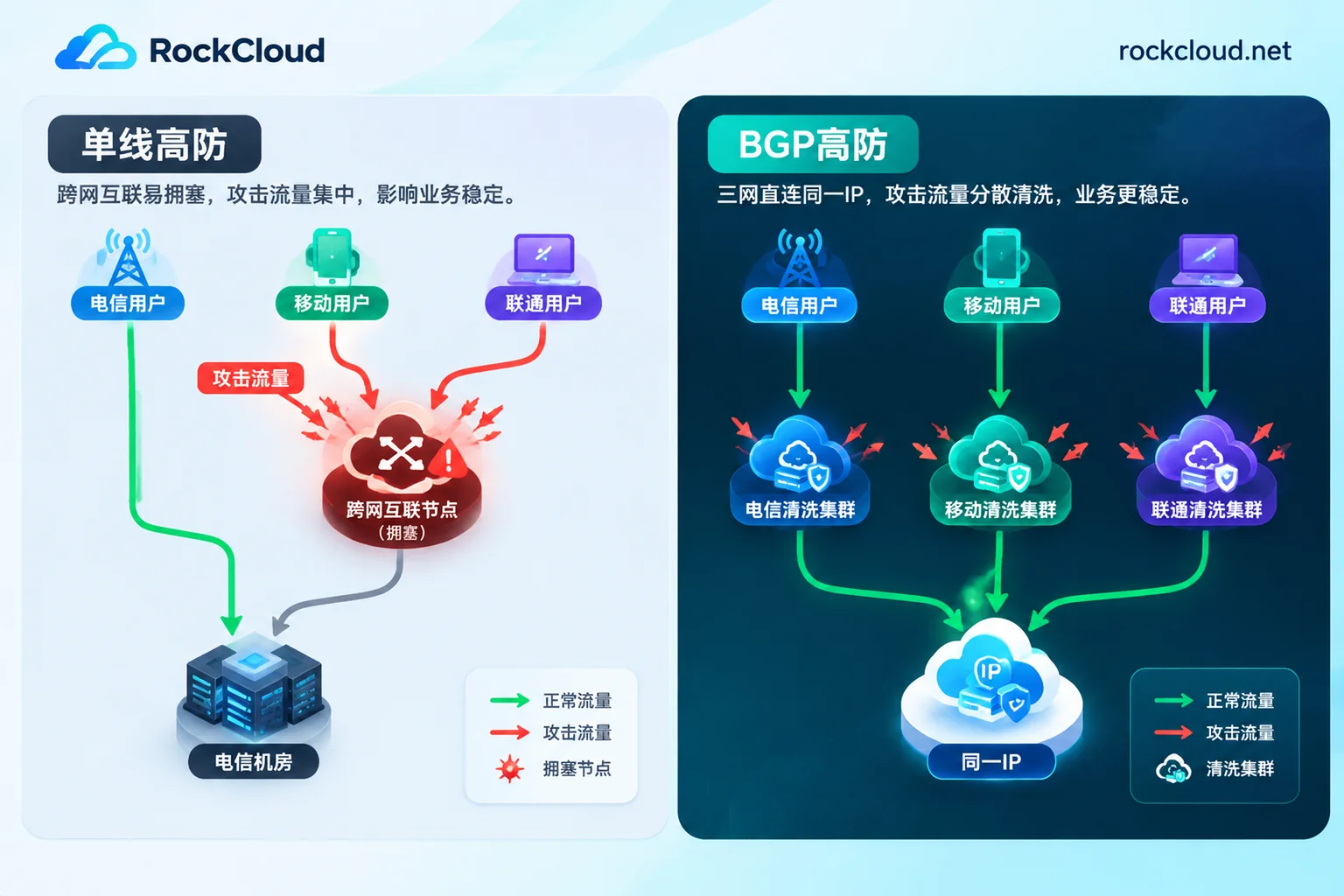
Single-line high-defense: strong in hard defense, weak across carriers
Single-line high-defense is generally deployed at a single carrier's backbone node, such as Telecom single-line or Unicom single-line.
Advantages:
- Users on the same carrier connect directly to the backbone with a short path and good access quality;
- Large-traffic hard defense has lower procurement cost, and with the same budget the paper defense value is higher.
Shortcomings:
- Off-net users must detour through interconnection nodes between carriers; for example, Mobile users accessing Telecom single-line will see noticeably higher latency and packet loss;
- During large-traffic attacks, cross-carrier interconnection links may become saturated earlier than the scrubbing equipment. The data center's scrubbing system may still be working normally, but off-net users can already be unable to access;
- Protection is concentrated in a single data center; if the attack exceeds that data center's capacity limit, blackholing is the only outcome.
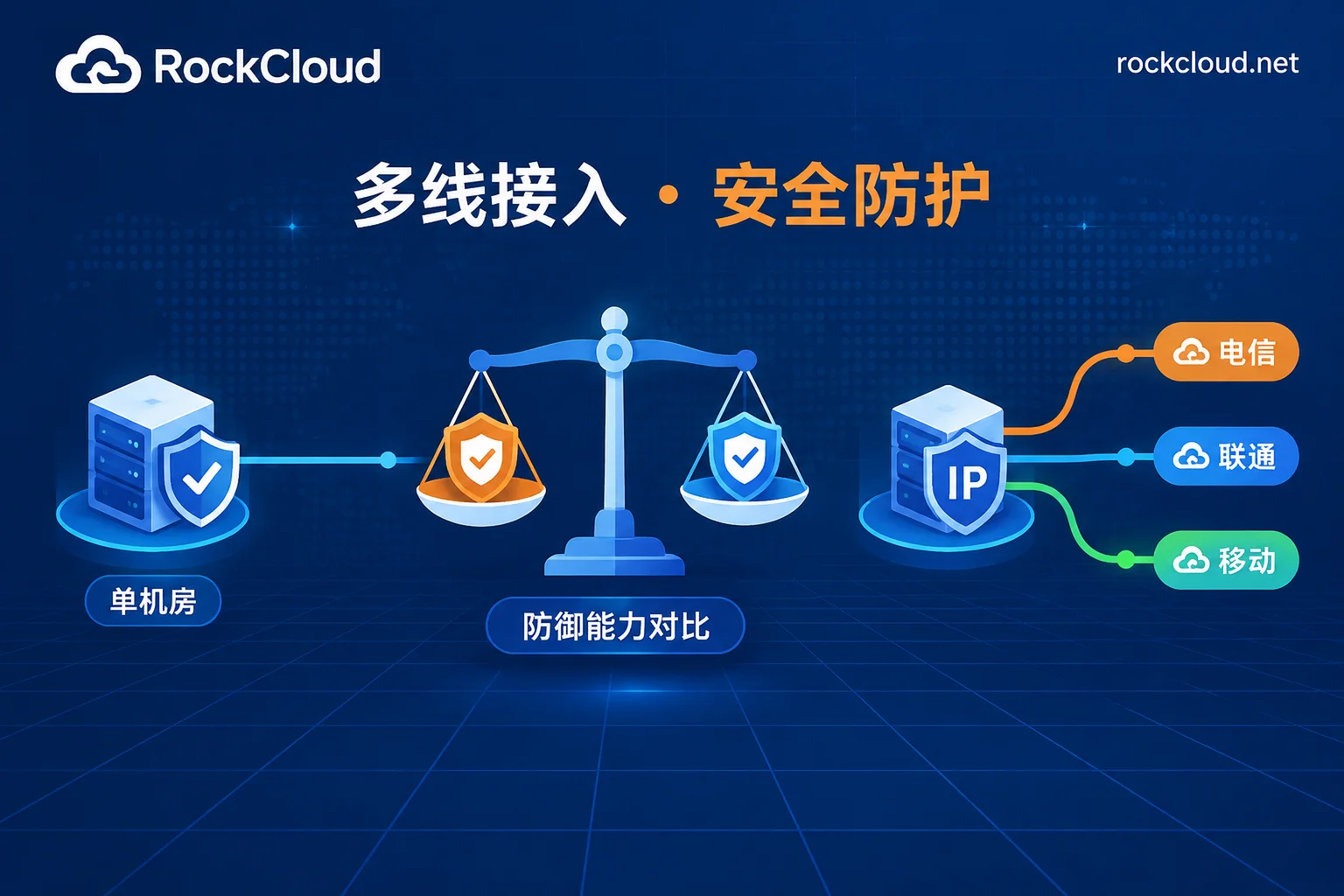
Some providers' "dual-line" or "triple-line" actually assigns one IP per carrier and then uses intelligent DNS to distribute traffic. This is not the same as single-IP BGP. Before procurement, ask clearly: does the business get one IP or multiple IPs?
BGP high-defense: strong in nationwide availability, at the cost of price
BGP high-defense uses Border Gateway Protocol to let the same IP connect to multiple carriers such as Telecom, Unicom, and Mobile at the same time. Carrier routing automatically selects a better path for users, and when a line is congested or fails, traffic can automatically converge to other lines.
This has three implications for defense:
- More consistent nationwide experience during an attack: there is no situation where "same-network users are fine but off-net users cannot access";
- Less likely to be broken through at a single point: newer cloud BGP high-defense mostly combines distributed or Anycast near-source scrubbing, spreading very large traffic across multiple backbone scrubbing clusters, making blackholing less likely than a single data center relying on raw capacity;
- Simple access: only one IP is needed, with no need to maintain multiple sets of resolution per carrier.
The cost is that BGP bandwidth itself is more expensive. For the same defense peak, BGP high-defense quotes are usually significantly higher than single-line. Some vendors advertise "BGP" but actually connect only a few carriers, so test three-network latency in practice rather than just looking at the wording on the page.
Choose by business
| Business situation | More suitable choice | Reason |
|---|---|---|
| Users are basically concentrated on one carrier, or it is an intranet or enterprise dedicated line business | Single-line high-defense | Good same-network quality, low hard-defense cost |
| Insensitive to latency and packet loss, limited budget, mainly defending against large traffic | Single-line high-defense | Can buy a higher defense peak at lower cost |
| Websites and APIs for nationwide users | BGP high-defense / multi-line high-defense acceleration | Users on all networks need access during an attack |
| Real-time competitive games, live streaming, trading and payment | BGP high-defense / multi-line high-defense acceleration | Jitter and disconnections directly cause user churn and financial risk |
| Main users are overseas or in Hong Kong/Macau, accessing back to mainland China | First look at line direction | Refer to Hong Kong CN2 vs Hong Kong BGP: which is better |
One more easily overlooked point: line type solves the network-layer large-traffic problem, but helps little with CC attacks. If the business is mainly hit by high-concurrency HTTP requests, whether single-line or BGP, what works is the layer-7 access frequency rules, WAF, and human verification. If you are still not sure which type of attack it is, first see how to tell whether a website is suffering a DDoS or CC attack; for specific layer-7 protection methods, refer to can high-defense CDN defend against CC attacks.
Things to ask and test clearly before procurement
- Is the defense peak guaranteed or elastic: the guaranteed part is included in the fee; how is the elastic part billed, how soon after exceeding it does blackholing occur, and how long does the blackhole last.
- Is it single-IP multi-line: ask the provider to explain which carriers are actually connected; if it only says "dual-line" or "triple-line", ask clearly whether it is a multi-IP solution.
- Actual three-network testing: during the trial period, ping and traceroute separately from Telecom, Unicom, and Mobile networks, preferably covering evening peak hours. For single-line high-defense, focus on testing off-net user access.
- Behavior during an attack: ask the provider whether there is rate limiting during large-traffic attacks, whether normal traffic is dropped, and what granularity of logs and alerts can be obtained.
- Whether the origin is well hidden: high-defense can only protect traffic that passes through it. Once the origin IP is leaked, attackers can bypass protection and hit the origin directly, and no matter how good the line selection is, it will not help. For how to close this off, see will the origin IP be exposed after accessing high-defense CDN.
Without buying a high-defense server, you can also delegate line issues to the protection layer
The comparison above is mainly for the deployment method of "placing the server in a high-defense data center." If the origin is already elsewhere and you do not want to migrate the server for defense, you can also add a layer of high-defense CDN or layer-4 proxy in front. Lines and scrubbing are handled by the protection provider's node network, and the origin only receives scrubbed back-to-origin traffic. At this point the selection question becomes: how good is the line quality of the provider's nodes, and how large is the scrubbing capacity.
RockCloud's DDoS and CC defense is this kind of access method: acceleration and defense are completed on the same link, only one fee is charged, billing is by fixed peak, and traffic is unlimited. For non-HTTP businesses such as games, you can choose the corresponding access method by protocol. For exactly how large an attack can be defended against and the access quality in each region, it is recommended to directly apply for a free test and judge using your own business's three-network data, rather than only looking at advertised parameters.


Comments(0)