 RockCloud-基石云安全-官方博客
In most cases, you don't need to buy a Hong Kong high-protection server directly.
First, determine whether your business has a realistic risk of being attacked and the cost of a single downtime. If protection is truly needed, then choose a solution based on your business protocol:
- For websites, APIs, cross-border e-commerce, and other HTTP/HTTPS businesses: Use a regular Hong Kong server as the origin, with a high-protection CDN/WAF in front. This approach is usually more cost-effective and less vulnerable to a single point of failure.
- For games and private TCP/UDP applications: Use a game shield or a Layer 4 high-protection IP.
- For legacy systems that cannot change DNS, cannot use a proxy or integrate an SDK, and must be directly exposed via a fixed public IP: In this case, buying a Hong Kong high-protection server is a necessity.
If you are currently under attack and your business is already disrupted, follow the recovery process first. You can refer to How to Determine If Your Website Is Under DDoS or CC Attack to confirm the attack type before returning to this selection guide.
First, Determine: Can You Accept a Few Hours of Downtime After One Attack?
High-quality bandwidth in Hong Kong is expensive, so the default defense thresholds for regular cloud servers and physical servers are generally low. They are commonly in the range of a few hundred Mbps to a few Gbps; refer to the data center's specifications for exact values.
Once attack traffic exceeds the threshold, the data center usually blackhole routes (RTBH) your IP to protect the backbone and other customers in the same facility, discarding all traffic destined for that IP. The block often lasts several hours, sometimes more than 24 hours. During this time, your business is completely unavailable, and no amount of server-side tuning will help.
So the question is not "Is the server configuration sufficient?" but "Can the business withstand a few hours of downtime after being hit?" If any of the following apply, plan for protection in advance:
- You have been attacked before or received extortion messages;
- You operate in competitive or high-traffic-sale industries such as gaming, live streaming, payments, or cross-border e-commerce;
- Your API is publicly exposed and has experienced abuse;
- The loss from one hour of downtime clearly exceeds the cost of protection.
For internal tools, test environments, and sites with low traffic where brief interruptions have little impact, you can start with a regular server. The prerequisites are: do not leak the origin IP, and prepare a fallback plan for when an attack occurs.
Why It's Not Recommended to Buy a High-Protection Server Directly When Protection Is Needed
A Hong Kong high-protection server can block some attacks, but for most businesses, it has several obvious shortcomings:
- High cost. The bulk of the price is Hong Kong local scrubbing bandwidth, and large-bandwidth resources with direct CN2 GIA connections are even more expensive.
- Fixed defense ceiling. The defense capacity is fixed at the amount purchased for the single machine; if an attack exceeds it, the IP will still be blackholed.
- Inadequate against application-layer attacks. CC attacks have low traffic volume and requests look like normal access, making them hard to identify through traffic scrubbing. They directly exhaust CPU, database connections, and resources beyond bandwidth. Hardware firewalls mainly target large-volume Layer 3 and 4 attacks.
- Direct IP exposure. Once attackers know the real IP, they can repeatedly target it.
Choose Architecture Based on Business Protocol
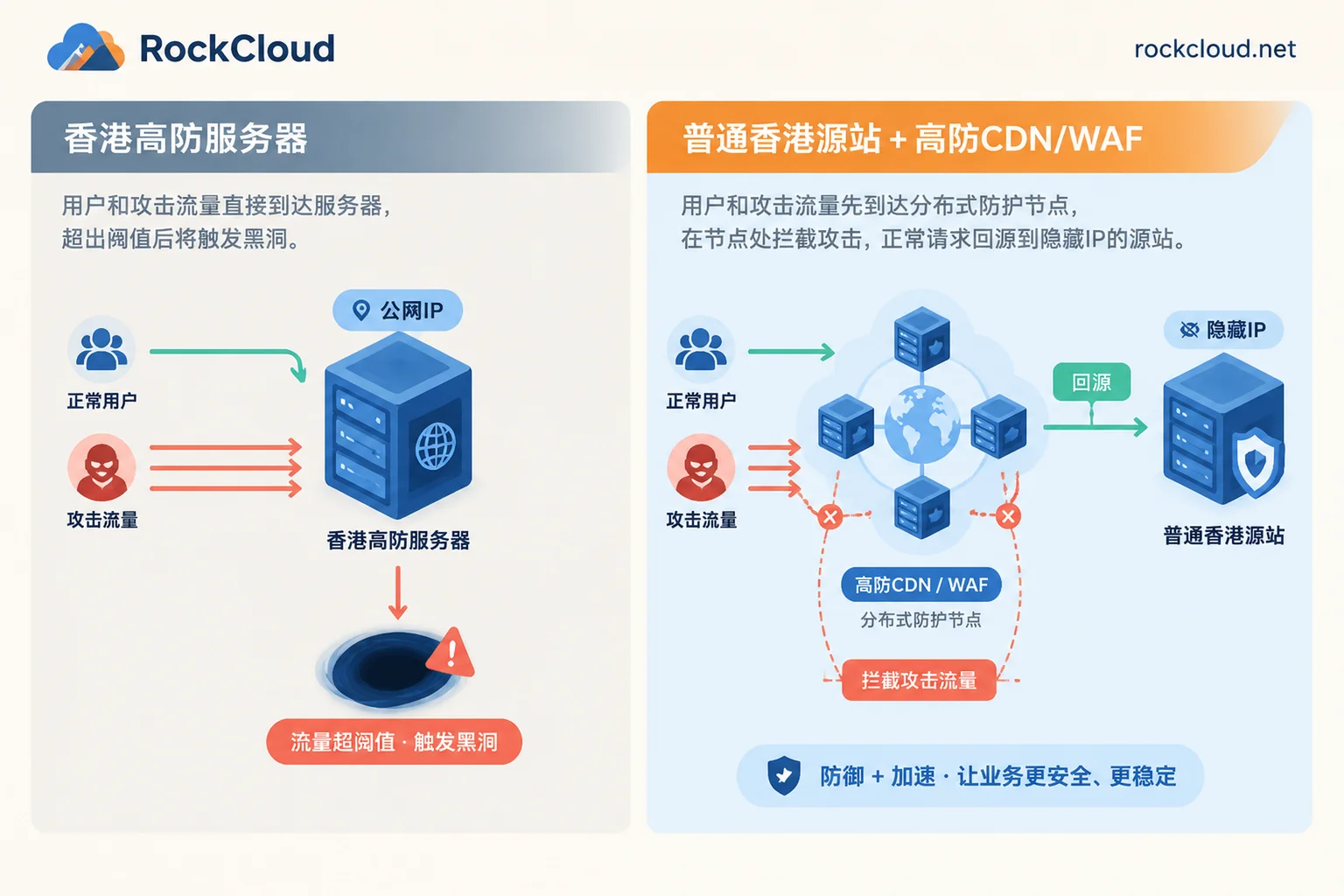
Websites, APIs, Cross-Border E-Commerce: Regular Hong Kong Origin + High-Protection CDN/WAF
The approach: CNAME your domain to high-protection nodes, so user requests first reach distributed nodes. Large Layer 3 and 4 attacks are scrubbed at the nodes; CC attacks and malicious crawlers are blocked at the edge by WAF and rate rules; only normal requests return to the origin. The real origin IP is not exposed, so attackers have no target.
Static resources can also be cached at the nodes, reducing origin pull and significantly lowering origin load. You only need to buy a regular configuration sized for normal business volume; you don't have to pay extra for attack peaks.
The effectiveness of this architecture depends on the following conditions:
- The origin IP must never have been exposed. If the old IP has been leaked through DNS history, email headers, missed subdomains, etc., it's best to switch to a new IP before onboarding. For specific troubleshooting methods, see Will the Origin IP Still Be Exposed After Using a High-Protection CDN?.
- The origin firewall should only allow pull requests from protection node IPs, and deny all other sources.
- All public domains must be onboarded, with no subdomains directly resolving to the origin.
- CC rules must be adjusted per business. Page and API access characteristics differ; using the same rate thresholds can cause false positives or misses. See Can a High-Protection CDN Defend Against CC Attacks?.
- Reconfirm the network route. If you originally chose Hong Kong for fast connectivity to mainland China, after onboarding, visitors connect to protection nodes, and the experience depends on the protection service's own routes. Before signing, ask whether the return route to China is CN2 and how it performs during peak hours.
Games, Private TCP/UDP: Game Shield or Layer 4 High-Protection IP
These businesses cannot use Layer 7 reverse proxies, so a high-protection CDN won't work. There are two common approaches:
- Game shield: Encapsulates private protocols via SDK, while hiding the real IP.
- Layer 4 high-protection IP: Performs port forwarding.
Both are more secure than directly exposing the main IP of an expensive Hong Kong high-protection server to the public internet. If a game has both HTTP interfaces for login and payment, and long connections for battles, you can split them by module and onboard separately. See Should Game Servers Choose High-Protection IP or High-Protection CDN? and Can Non-Website Businesses Use High-Protection CDN?.
Rare Cases: When You Should Indeed Buy a Hong Kong High-Protection Server
Only when all the following conditions are met should you buy directly:
- The system cannot change DNS configuration;
- It cannot use a reverse proxy or integrate an SDK;
- The client has a hardcoded IP, and communication must be carried directly over a fixed public IP.
Even if you must buy, clarify four things before signing:
- What is the defense threshold?
- How long will the blackhole last after exceeding the threshold, and can it be lifted early?
- Is there application-layer CC protection?
- What is the return route to China?
| Business Type | Recommended Approach | Key Prerequisites |
|---|---|---|
| Websites, APIs, cross-border e-commerce | Regular Hong Kong origin + high-protection CDN/WAF | Origin IP not exposed, only allow pull requests |
| Games, private TCP/UDP | Game shield or Layer 4 high-protection IP | Can integrate SDK or perform port forwarding |
| Legacy systems, fixed IP direct connection | Hong Kong high-protection server | Clarify threshold, blackhole duration, CC protection |
How to Compare Costs
A high-protection server is a bundled purchase of "server + defense." To adjust defense capacity, you often need to replace the entire machine.
With a front-end protection solution, the two costs are calculated separately: the server is purchased according to business scale, and protection according to risk, each independently adjustable.
When comparing prices, besides the monthly fee, also confirm the following:
- Is billing based on traffic or peak?
- Is attack traffic billed?
- Are acceleration and protection charged separately?
For a more detailed calculation, see Which Is Cheaper, High-Protection IP or High-Protection CDN?.
Next Steps
If your business is a website or API and you plan to use a regular Hong Kong server with front-end protection: RockCloud's high-protection CDN integrates acceleration and DDoS/CC defense in one link, charges a single fee, and includes WAF; it is billed by fixed peak with unlimited traffic. You can test for free first and validate with your own business traffic. The entry point is DDoS Protection.
For game or private protocol businesses, see Game Shield.
The server itself still needs to be purchased from a data center or cloud provider; RockCloud only handles front-end acceleration and protection.


Comments(0)