 RockCloud-基石云安全-官方博客
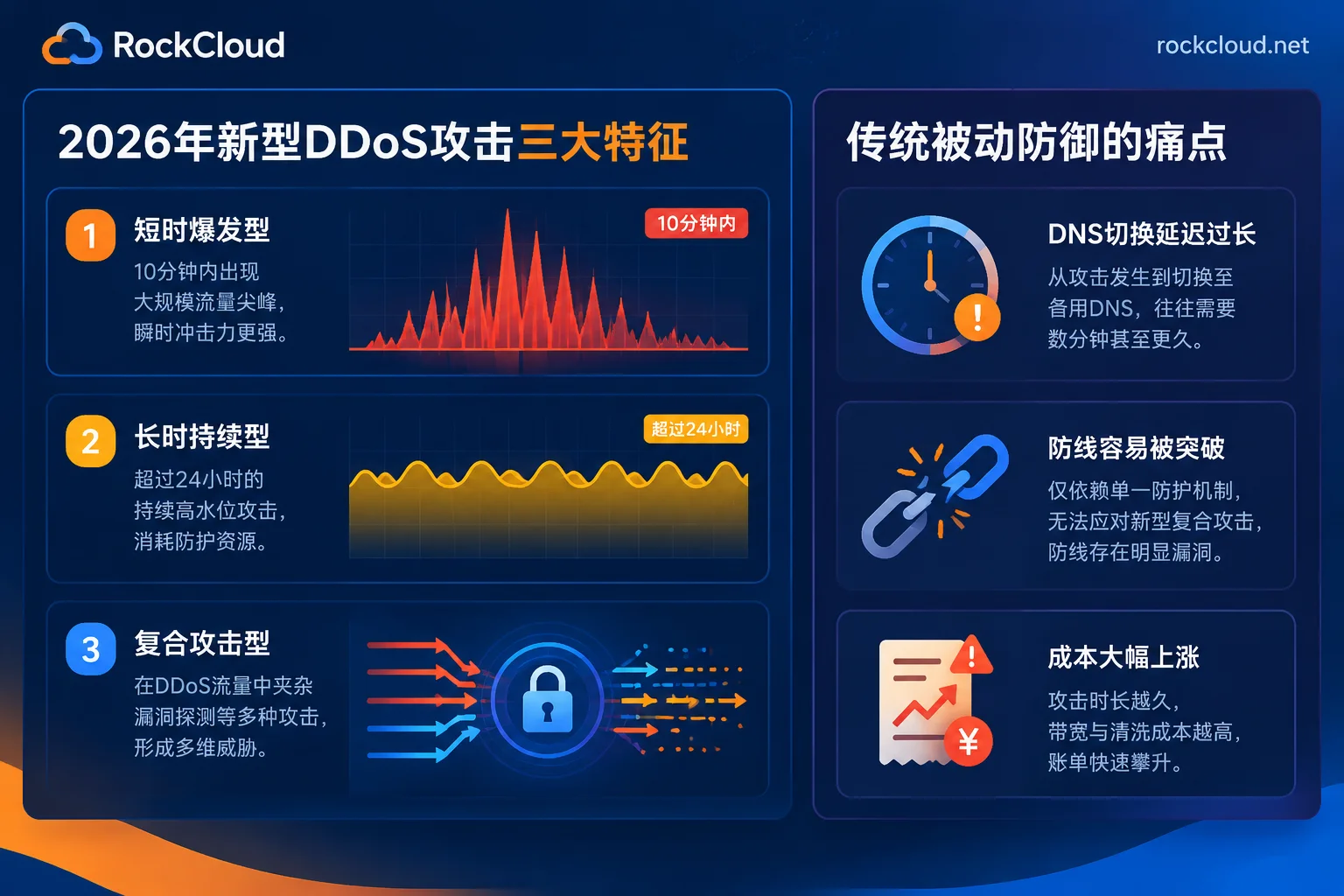
Multiple global threat intelligence reports released in the second half of 2026 reveal a qualitative shift in the rhythm and forms of cyberattacks. In the 2026 semi-annual DDoS threat reports successively published by Cloudflare, NETSCOUT, and domestic security agencies, four sets of data directly expose the defense dilemmas enterprises currently face:
- Network-layer attacks enter "minute-level blitzkrieg": 90.6% of network-layer (L3/L4) DDoS attacks end within 10 minutes, and the proportion of "pulse-style" hired attacks lasting 1 minute or even shorter has doubled compared to previous years.
- Polarization between ultra-large floods and application-layer attrition: Ultra-large attacks exceeding 1 Tbps surged 519% to 1286% in the first half of 2026; meanwhile, ultra-long application-layer (L7) attacks lasting over 24 hours soared by 380%.
- Compound attacks deeply bundled with vulnerability probing: 70.97% of attacks use multi-vector stacking. Attackers commonly use large-traffic DDoS or high-frequency CC as a "smoke screen" to consume operations effort while concurrently executing millions of Web vulnerability scans and injection attempts.
- Shift from pure disruption to "disconnection + ransom" profit: 65% of DDoS attacks are bundled with ransom or data theft, highly concentrated in industries extremely sensitive to real-time online rates, such as payments, finance, gaming, AI services, streaming media, and cross-border APIs.
Facing this industrialized, high-frequency attack posture, traditional passive models—"run naked to save costs in peacetime, manually switch lines after being hit" or "single-point procurement of hardware/high-defense IPs"—have completely failed. To ensure business continuity in the 2026 threat environment, enterprises' DDoS defense must upgrade from emergency response to an architecture design that is "always-on, same-path, and multi-layer collaborative."
I. Why Do Traditional Passive DDoS Defenses Frequently Fail in 2026?
In actual emergency response cases, many business owners find that: even though they have purchased backup protection, or the server room comes with some basic defense, business still frequently interrupts under attacks. Combined with current attack characteristics, traditional defense lines have three main structural weaknesses:
1. Manual switching speed cannot catch "minute-level" pulse attacks
When 80% to 90% of network-layer attacks complete burst and retreat within 10 minutes, the process of "monitoring alert → operations confirmation → temporary DNS change or route switching" cannot be completed in time. Regarding switching time, we have detailed calculations in "How Long Does It Take for High-Defense Line Switching to Take Effect: DNS Changes Take Minutes to Hours, BGP Traction in Seconds, Always-On Access Requires No Temporary Switching": by the time DNS cache refresh takes effect, the first wave of pulse attacks has long ended, but your origin connection table is already full, the database is deadlocked, and the server has been blackholed by the data center; when you prepare to switch back to the original line, the attacker's second 1-minute pulse arrives.
2. L3/L4 scrubbing and L7 defense are disconnected, breached by "smoke screens"
Many enterprises are accustomed to purchasing DDoS protection, CC protection, and Web Application Firewall (WAF) separately or connecting them in layers. However, with over 70% being compound attacks today, attackers often first probe bandwidth limits with DNS reflection or UDP floods, then immediately launch rate-based CC attacks that do not reach link saturation thresholds but are sufficient to exhaust backend resolvers and application connection pools, mixed with SQL injection and malicious crawler scans. If network-layer scrubbing nodes and WAF are not on the same path, not only does latency add up, but policies cannot be linked, making it easy to lose one while focusing on the other.
3. Pay-per-traffic model becomes a financial disaster under "L7 attrition"
For application-layer CC tug-of-war lasting 24 hours or even days, and reflection floods of hundreds of Gbps, if using ordinary cloud CDN with post-payment based on requests or outbound traffic (GB), even if the business does not go down, the elastic overage bill at the end of the month will directly become another form of "financial ransomware" (see "What to Do When CDN Is Maliciously Abused and DDoS Attacks Generate Sky-High Bills: Pay-As-You-Go Traps and High-Defense CDN Selection Guide").
II. Four Core Architectural Pillars of Modern DDoS Defense
Addressing the four pain points of "short pulses, long CC, compound penetration, and high bills," high-availability businesses should plan DDoS defense with always-on edge scrubbing as the core, building a four-layer closed-loop defense line.
Pillar 1: Anycast distributed always-on access eliminates "emergency time gap"
The only solution against minute-level pulse attacks and Tbps-level burst floods is to keep protection always online and leave scrubbing actions at the network edge.
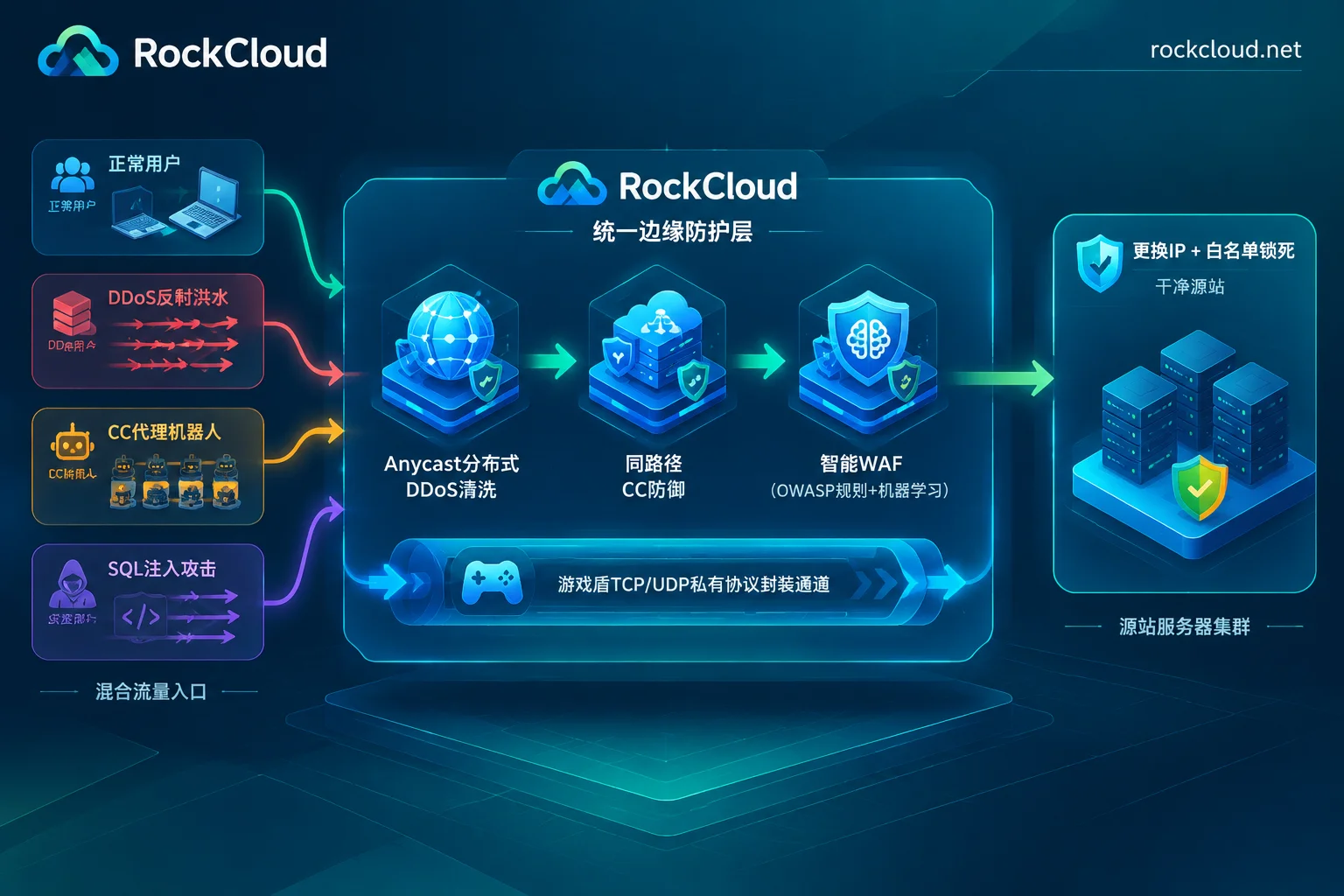
By accessing RockCloud High-Defense CDN and DDoS/CC Defense, business traffic in daily state is pulled nearby through global Anycast distributed nodes (for working principles, see "How BGP Anycast Scrubbing Works: How Traffic Is Pulled Nearby, Layered Scrubbing, and Re-injected to Origin").
- No server migration needed: The protection layer directly stands in front of the customer's existing origin servers or major international cloud hosts, and the origin architecture does not need to be rebuilt.
- No NS change, smooth access: Only add a CNAME record at the original DNS provider to complete access; DNS management rights remain in place, old and new links run in parallel during switching, with zero business interruption.
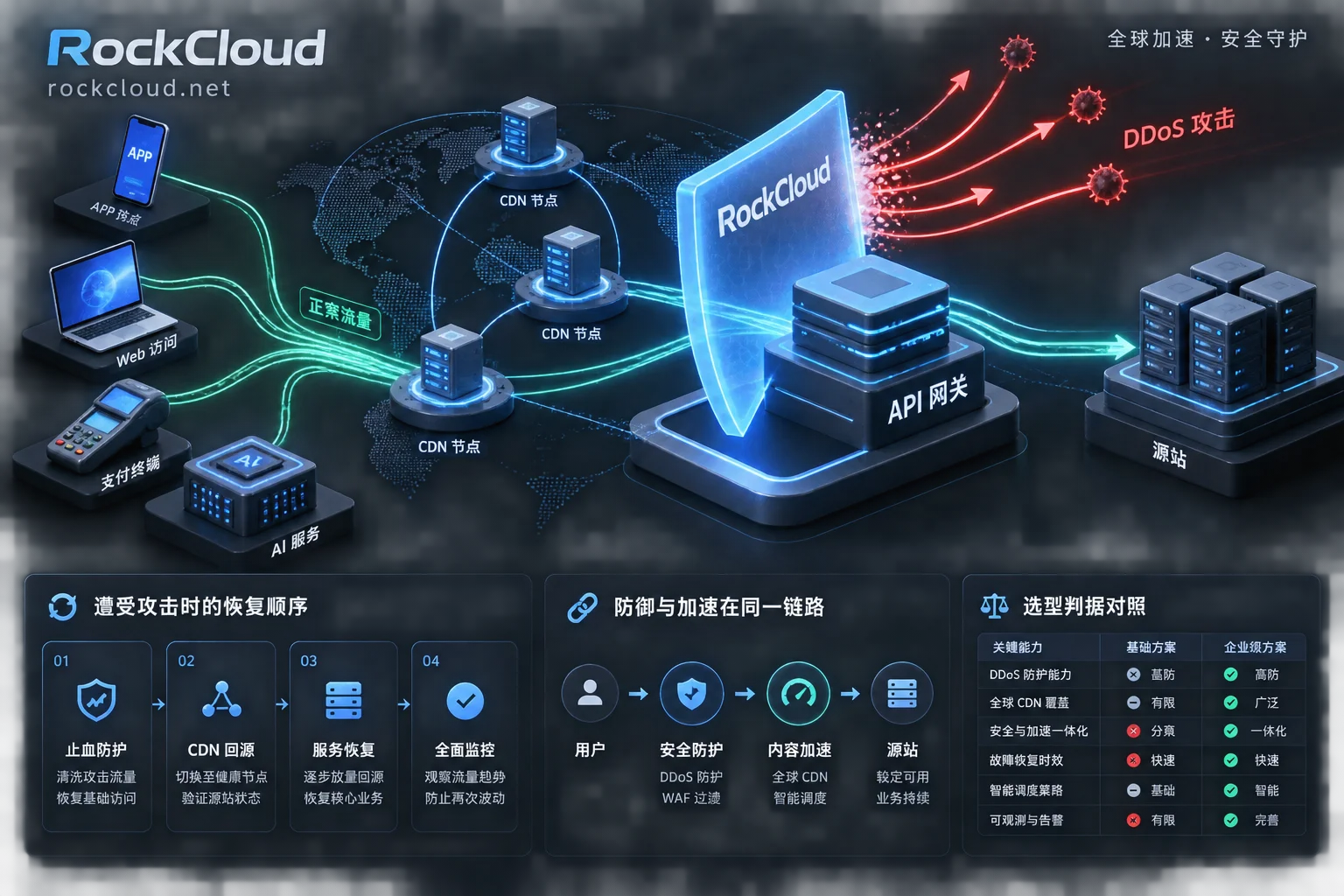
- Acceleration and defense combined: Always-on access fears affecting normal user access speed in peacetime. RockCloud integrates global CDN acceleration and security scrubbing on the same request path, supporting HTTP/3, TLS 1.3 0-RTT, and Brotli compression; for overseas no-ICP businesses targeting mainland China, it can also add CN2 China acceleration dedicated lines with China Telecom CN2 GIA, China Unicom AS9929, and China Mobile CMI direct connections, achieving "acceleration in peacetime, second-level DDoS resistance in wartime."
Pillar 2: DDoS, CC, and intelligent WAF collaborate on the same path to dismantle "compound attacks"
Facing multi-vector hybrid attacks of "network-layer floods + application-layer slow CC + vulnerability scanning," defense must complete filtering at once within the same edge node (to learn how to quickly identify attack types, see "How to Determine Whether a Website Is Under DDoS or CC Attack: Four-Step Troubleshooting and Corresponding Handling").
In RockCloud's protection system, DDoS and CC defense are on the same request path, with no need for separate purchase or multiple forwarding. On this basis, users can enable Intelligent WEB Firewall (WAF) with one click in the control panel:
- Known threat interception: Built-in OWASP core rule set at the bottom layer directly intercepts SQL injection, XSS cross-site scripting, file inclusion, command injection, malicious scripts, and automated scanner and bot requests mixed in DDoS traffic at the edge.
- Unknown attack identification: For new CC and new API attacks launched via residential proxies with highly deceptive characteristics, machine learning dynamically identifies anomalous malicious requests not yet included in the rule base.
- Expert-assisted tuning: When encountering complex ransom attacks, custom rules and business interface exceptions are configured with assistance from RockCloud security technical team, avoiding false blocking of normal payment callbacks or client API requests due to overly strict policies.
Pillar 3: Protocol-based division—Web/API goes through high-defense CDN, TCP/UDP goes through game shield
Attackers do not only hit ports 80/443. For businesses containing non-HTTP protocols (such as mobile games, card games, real-time voice, IM instant messaging, or custom TCP/UDP communication protocols), relying solely on Web-layer high-defense CDN cannot cover all ports.
A reasonable DDoS defense architecture should decompose modules by protocol (refer to "Can Non-Website Businesses Use High-Defense CDN: First Identify Protocol, Then Choose High-Defense CDN, L4 Proxy, or Game Shield"):
- Websites, H5, APP interfaces, and Web APIs: Directly access via high-defense CDN, while using security tokens and signed URLs, IP and region black/white lists, anti-leech and other general security features to tighten access permissions.
- TCP/UDP full-protocol and long-connection businesses: Use Game Shield access. Game Shield encapsulates non-HTTP protocols with private protocols, forwards via distributed edge nodes, and completely hides the origin; when an edge node encounters a pulse flood attack, the system automatically switches to a high-defense node while keeping player or client connections uninterrupted, completely solving the chronic problem of traditional high-defense switching causing all users to drop.
Pillar 4: Completely hide and lock down origin IP to prevent "bypassing scrubbing and hitting origin directly"
NETSCOUT's 2026 report specifically points out that direct-path attacks have risen to 64% of observed attacks. Once the real origin IP is exposed, attackers will bypass CDN or high-defense nodes and directly launch flood attacks or "carpet bombing" against the origin data center.
Accessing high-defense is only the first step; origin lockdown is the key to determining the defense lower bound (for detailed troubleshooting steps, see "Will Origin IP Still Be Exposed After High-Defense CDN Access: Five Leak Paths, Lockdown Order, and Handling After Exposure"):
- Replace exposed origin IP: If emergency access is during an ongoing attack, it means the current origin IP is already on the attacker's target list; while accessing high-defense, you must simultaneously apply to the data center or cloud provider to change the origin IP.
- Firewall whitelist lockdown: Configure strict access control policies on origin servers or cloud security groups, only allowing high-defense back-to-origin node IP ranges, and rejecting any direct probing and connection requests from other public IPs.
- Supporting cloud resource isolation: For teams using AWS, Azure, GCP, or Alibaba Cloud International, Tencent Cloud International, Huawei Cloud International as origins, they can also use international cloud recharge services to quickly open new accounts or supplement computing power (no enterprise certification or cumbersome real-name procedures, supports USDT payment), combining with high-defense CDN and game shield to build a clean origin environment.
III. Defense Focus and Cost Control for Key High-Risk Industries
Different business forms have different vulnerabilities when facing high-frequency DDoS and ransom attacks in 2026. When checking solutions by industry, it is recommended to focus on the following configurations:
| Business Type | Typical Attack Threats in 2026 | Core Defense and Architecture Recommendations |
|---|---|---|
| Payment, Finance, and Web3 | DDoS ransom letter threats, high-concurrency order-brushing interfaces, hybrid WAF vulnerability probing | Enable high-defense CDN + intelligent WAF; strictly configure API path rate limits and region black/white lists; enable Telegram real-time data push to monitor abnormal peaks. |
| AI Services and WEB APIs | Residential proxy high-frequency calls exhausting GPU computing power, slow CC filling connection pools | Combine signed URL/security token authentication; use machine learning WAF to filter non-human requests; origin only opens ports to back-to-origin nodes. |
| Card Games, Mobile Games, and IM | Minute-level UDP pulses causing disconnections, simulated real-player protocol connections exhausting resources | Login/update/lobby HTTP interfaces go through high-defense CDN; core battles and long connections go through Game Shield private protocol encapsulation, achieving node switching without disconnection. |
| Live Streaming and Short Video | Tbps-level floods during events/promotions, malicious CDN traffic abuse generating sky-high bills | Use Video CDN with security tokens, IP blocking, and Multi-DRM anti-piracy; choose fixed-peak billing mode with unlimited traffic. |
| Cross-border E-commerce and Overseas Portals | Multi-region concurrent CC attacks, operator blocking or DNS pollution in some regions | High-defense CDN plus blocking and pollution recovery (DNS pollution scrubbing, WeChat/QQ and regional operator blocking recovery without changing domain). |
Calculate the economics of defense: reject pay-as-you-go elasticity traps
In today's normalized attacks, cost predictability of DDoS defense is as important as the defense upper limit. If selected improperly (refer to Selection Comparison: vs. Alibaba Cloud, Cloudflare, AWS, Traditional High-Defense Servers), high traffic bills or separately stacked WAF fees will overwhelm enterprises.
In the RockCloud package billing system, we adopt a transparent mechanism more suitable for high-risk businesses:
- Monthly fixed peak billing, unlimited traffic and requests: Whether application-layer CC lasts 24 hours or weeks, no matter how many billions of malicious HTTP requests are generated, no pay-as-you-go overage traffic bill will be incurred.
- All features included, security capabilities not sold separately: Acceleration and defense are in the same package, with DDoS defense, CC defense, intelligent WAF, and free fully automated SSL certificates all included, no extra payment for defense modules.
- Flexible business and free testing: Support contract quotation and USDT or USD payment; before formal procurement, contact customer service to determine business specifications and apply for free testing.
IV. Under DDoS Attack Right Now? Four-Step Emergency Stop Checklist
If your website, API, or game server is currently under DDoS or CC attack, with large-scale timeouts, packet loss, or origin IP blackholed, please immediately handle in the following order:
- Do not just tough it out at the origin: Kernel tuning on a single server or ordinary cloud host (such as modifying sysctl parameters, using iptables to block IPs) is useless against hundred-Gbps floods and distributed proxies; you must introduce an edge scrubbing layer immediately.
- Quickly pull Web/API traffic via CNAME: Keep the original DNS provider unchanged, modify the resolution record of the attacked domain to the CNAME address assigned by high-defense CDN, quickly pulling traffic to Anycast scrubbing centers.
- Simultaneously change origin IP and lock down security groups: Contact the host provider to change the exposed origin public IP, and set the origin firewall to only allow high-defense back-to-origin node IPs, completely cutting off attackers' direct paths.
- Call in professional security response team: Facing multi-vector hybrid attacks or ransom attacks, directly contact RockCloud security engineers via Contact Us (the "Security Response" channel is specifically for attack emergencies) or official Telegram (@rockclouds) for assistance with emergency access, IP change lockdown, and targeted WAF scrubbing rule customization, restoring business online as quickly as possible.



Comments(0)