RockCloud-基石云安全-官方博客
For websites, apps, API interfaces, games, and live streaming platforms operating across multiple regions or countries, the most insidious and deadly traffic cliff is often not server downtime, but DNS pollution. The source server's CPU, memory, and bandwidth monitoring are all normal, and overseas or some regional probes are all green, but real users in specific provinces and specific ISPs集中反馈 "webpage cannot open", "connection timeout", or are directly redirected to unfamiliar pages.
Recent network security monitoring shows that interference methods targeting domain resolution chains are escalating: not only traditional UDP port 53 spoofed responses from intermediate nodes, but also composite pollution incidents that combine abnormal BGP route announcements to divert resolution traffic to specific networks and then tamper with DNS response packets in transit, affecting hundreds of thousands of domains in a single event, causing widespread anomalies in regular websites, API calls, and certificate status checks.
When a business domain falls into this situation, many operations teams search online for "how to solve DNS pollution" and often get "client-side tutorials" aimed at individual internet users. As a business owner or architect, if you copy these methods for fault recovery, you will only watch public traffic and conversion rates drop to zero. This article will dissect the underlying logic of DNS pollution cleaning from a server-side engineering perspective and provide a production-grade recovery and hardening architecture that does not change domain names or trouble end users.
I. Why Can't the "Conventional Self-Salvation Tutorials" Online Save Commercial Businesses?
When troubleshooting and dealing with domain pollution, enterprises are most likely to fall into three costly misconceptions:
Misconception 1: Issue announcements teaching users to change public DNS, clear cache, or enable DoH/DoT
Many technical articles suggest changing the device's DNS to 8.8.8.8, 1.1.1.1, or configuring encrypted DNS over HTTPS (DoH) / DNS over TLS (DoT) on the client, and executing ipconfig /flushdns in the command line.
- Why it's ineffective for businesses: This solution only applies to internal employee office networks or geek groups. For public visitors of e-commerce, content sites, games, or payment interfaces, when a page fails to open for more than 3 seconds, users will simply close the page or even uninstall the app. It is impossible for them to modify the underlying network configuration of their phone or router just to access your website. In addition, some public DNS IPs themselves may be subject to routing-level interference or forged spoofed responses in specific network environments, and even if ordinary users change them, they may not work.
Misconception 2: Believing that adding a layer of ordinary resolution service or enabling DNSSEC to the origin will make you immune
Some teams believe that hosting the domain with a well-known overseas DNS provider or enabling DNSSEC signature verification will completely immunize against pollution.
- Why it's ineffective for businesses: The role of DNSSEC is to use cryptographic signatures to verify whether resolution records are issued by authoritative servers, preventing recursive resolvers that support validation from accepting forged records. However, real-world cross-network DNS pollution often occurs on the "last mile" or international egress links—intermediate nodes detect plaintext domain requests and directly inject forged A record IPs to clients or local recursive servers (Local DNS) that do not support mandatory validation, or simply drop normal handshake packets. At this point, encrypted signatures cannot restore normal communication for packets that have been forcibly blocked or tampered with.
Misconception 3: Abandoning the old domain and switching to a new one immediately upon pollution
To quickly recover business, many teams choose to "shoot and move", directly purchasing new domains to replace old ones.
- Why it's ineffective for businesses: Every domain change means long-accumulated SEO search engine weight and indexing are reset to zero, historical backlinks and ad landing pages all become invalid, and old user bookmarks cannot be accessed; for app or desktop client businesses, once the API communication domain hardcoded in old package versions is abandoned, a large number of existing users who haven't updated their clients will be permanently lost.
The real commercial-grade self-salvation must be completed on the server side and network edge. If you are not yet familiar with the preliminary troubleshooting of different blocking forms, you can first read our previous troubleshooting guide: How to Recover from Domain Blocking: First Distinguish DNS Pollution, ISP Blocking, and WeChat/QQ Blocking, and Recover In-Place Without Changing Domain Names. This article will build on that and further analyze the cleaning mechanism of link pollution and cross-border network hardening solutions.
II. Dissecting the Resolution Black Box: How Do DNS Pollution and Recursive Cache Poisoning Occur?
To perform effective DNS pollution cleaning, you first need to see at which step normal resolution requests are replaced by "dirty data".
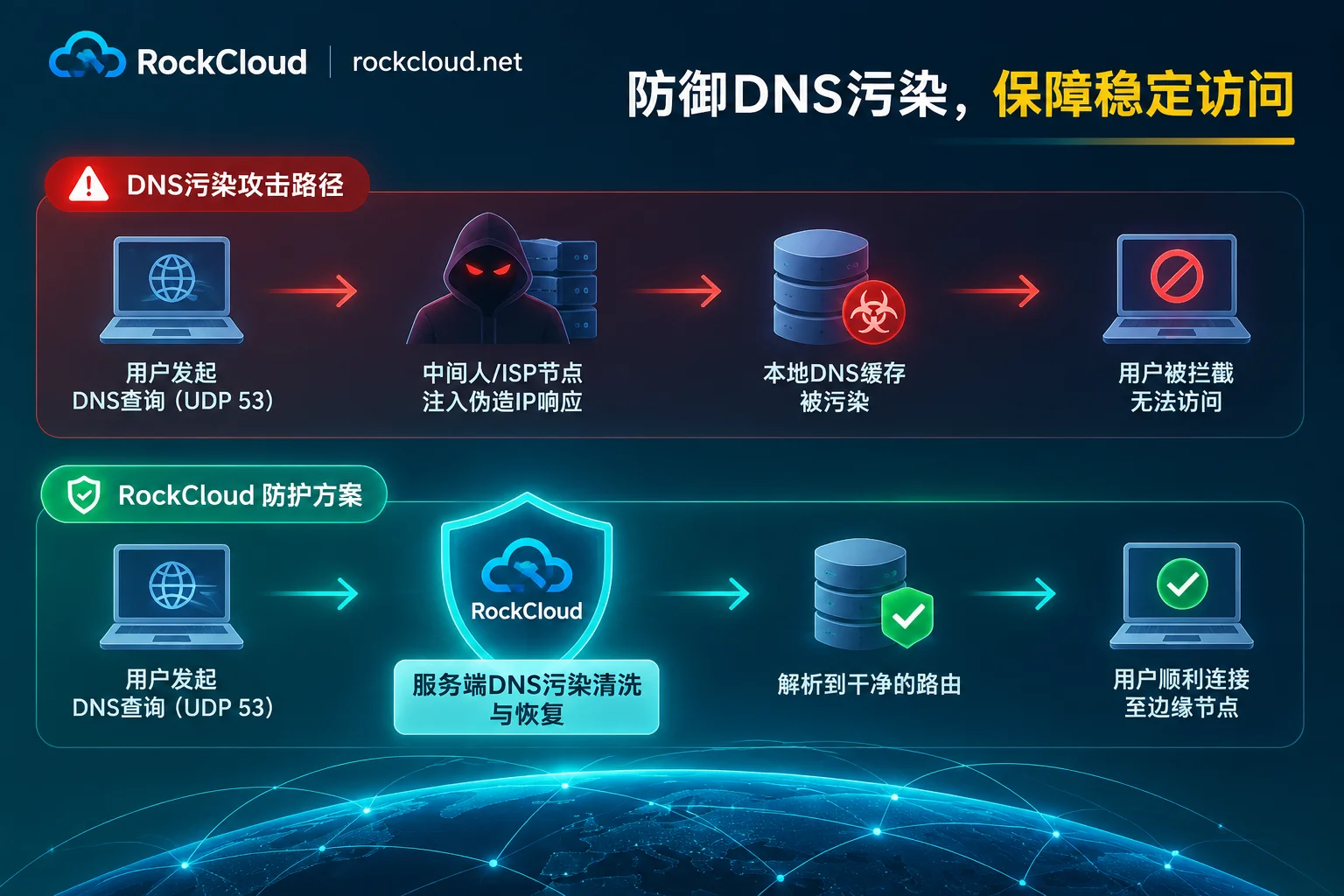
As shown in the figure above, when an end user initiates access, the request first reaches the ISP's Local DNS (local recursive server). In cross-region or cross-border access scenarios, pollution usually takes effect through the following two mechanisms:
- Bypass monitoring and millisecond-level UDP spoofed responses: Traditional DNS queries are by default transmitted over connectionless, unencrypted UDP port 53. When a query packet passes through international egress or specific backbone bypass devices, once it matches the characteristics of an interfered domain, the bypass device, before the real authoritative DNS server's response returns, uses its physical distance advantage to抢先 return a forged response packet to the requester within milliseconds (pointing to a null route IP, blackhole address, or anti-fraud/warning page IP). The requester accepts the first matching response and discards the subsequently arriving real IP.
- Recursive cache poisoning (Cache Poisoning) propagation: More troublesome is that once an ISP's recursive server in a region receives a forged spoofed response, or an attacker hijacks BGP routes to tamper with return packets in transit, this incorrect IP mapping is written into the recursive node's cache. Before the TTL (Time To Live) expires, subsequent normal users in that region accessing the same domain, even without triggering bypass spoofed responses, will directly obtain the incorrect resolution result from the local ISP cache.
Moreover, in actual business, DNS pollution rarely appears alone. It is often intertwined with regional ISP HTTP/SNI blocking, red page blocking by built-in browsers of social platforms like WeChat/QQ, and even DDoS/CC probing attacks against the origin IP. If only a single-point resolution switch is done without cleaning and edge protection architecture support, the recovered domain often falls back into paralysis within a few days.
III. Server-Side Breakthrough: How Does RockCloud Achieve DNS Pollution Cleaning Without Changing Domain Names?
For core domains that have already suffered pollution or are at high risk of blocking, the RockCloud Blocking and Pollution Recovery Solution abandons the compromise of requiring users to change configurations or forcing enterprises to abolish their primary domain, and directly provides engineered cleaning and recovery capabilities at the network edge and distribution layer:
1. Targeted DNS Pollution Cleaning and Resolution Recovery
When a domain encounters cross-network resolution pollution, RockCloud uses a dedicated DNS pollution cleaning mechanism to purify and intervene in the interfered domain resolution chain. Without the business party abandoning the original domain, the system can strip away the interference of forged responses at the server level and guide access traffic from various regions to re-obtain the correct reachable path to edge nodes, fundamentally solving the chronic problem of "ping domain pointing to unfamiliar overseas IPs or blackhole IPs".
2. Synchronized Multi-Dimensional Blocking Relief: ISP Blocking + WeChat/QQ Blocking Recovery
Often, operations teams think it's only DNS pollution, but after cleaning they discover the domain has also been added to a provincial ISP blocking blacklist, or is prompted "this webpage has been stopped from visiting" in the WeChat/QQ promotion ecosystem.
RockCloud's recovery system integrates DNS pollution cleaning with domain blocking recovery for platforms like WeChat, QQ, and regional ISPs into the same service. Combined with seamless 301 redirect technology, while keeping the promotion entry domain and external primary domain unchanged, social fission links, H5 landing pages, and main site business can resume normal opening simultaneously, preserving prior SEO weight and ad ROI.
3. Smooth Onboarding with Just One CNAME, No NS Record Changes
When performing pollution recovery or onboarding protection, many enterprises fear most that the service provider requires changing the domain's NS (Name Server) authoritative resolution servers—because the enterprise often has corporate email (MX records), internal OA subdomains, and various TXT verification records under the same root domain. Once NS is fully migrated, it can easily cause related business interruptions or long global propagation waiting periods.
When onboarding RockCloud High-Defense CDN and the pollution recovery architecture, you only need to add one CNAME record for the business subdomain that needs protection and recovery, without modifying NS; DNS remains with your familiar provider. During the switch, old and new links can run in parallel, achieving zero-downtime smooth transition.
IV. How to Achieve Long-Term Stability After Cleaning? Build a Closed Loop of "Anti-Hijacking + CN2 Return + High-Defense"
Completing initial DNS pollution cleaning and making the domain accessible again is only the first step. If the origin IP remains exposed on the public internet, or cross-border transmission still "runs naked" on congested and interference-prone public international egress, the domain will soon face secondary pollution or malicious attacks.
To avoid falling into the vicious cycle of "recover—blocked again—recover again", it is recommended to directly incorporate the business after pollution cleaning into RockCloud's defense-in-depth and cross-border acceleration closed loop (for architecture design of blocking recovery, you can also refer to our extended reading: "Why Can't Domain Blocking Recovery Rely Only on Appeals or Changing Domains? A Closed-Loop Architecture from In-Place Recovery to Anti-Secondary Blocking").
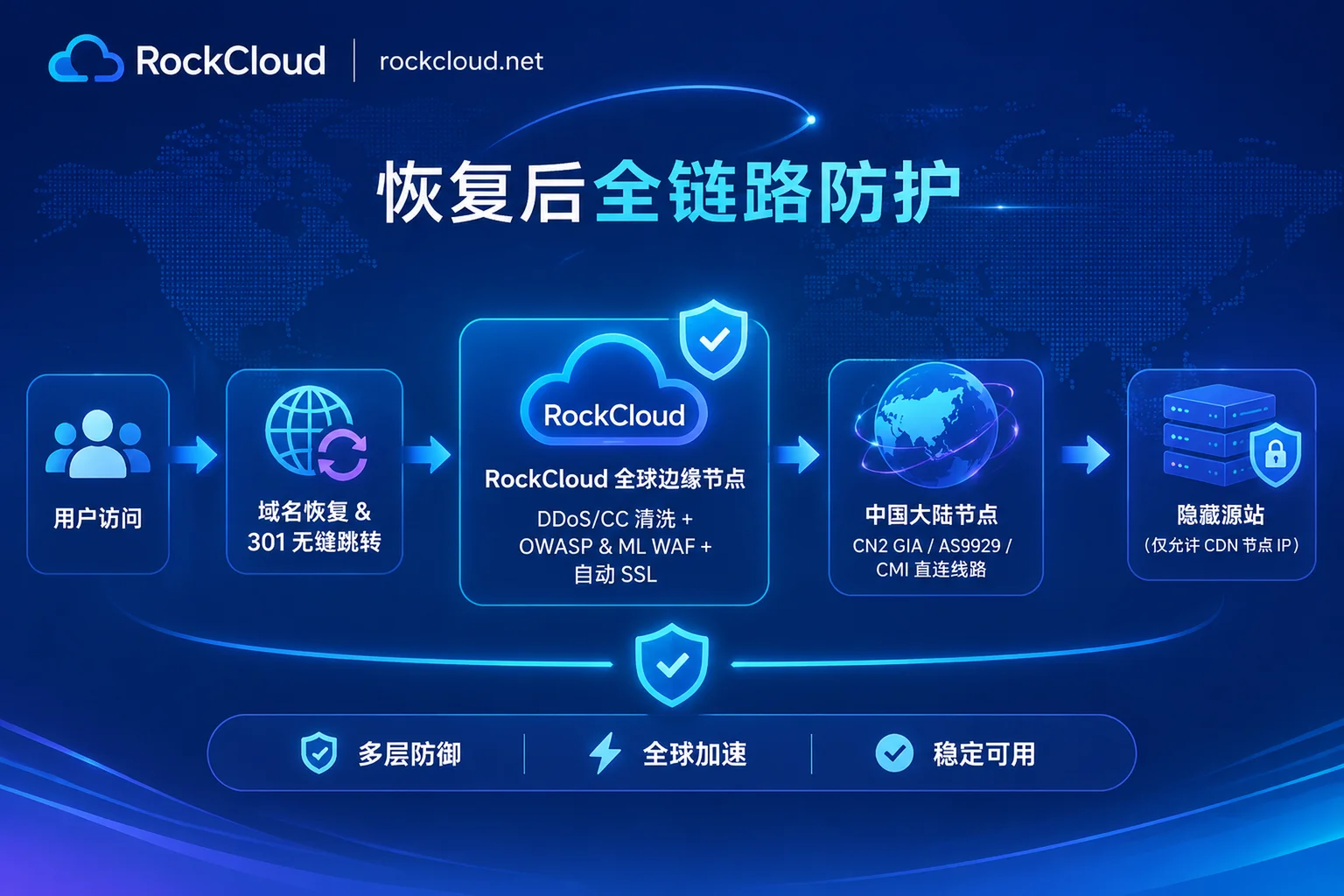
1. Hide Origin IP and Fully Automatic HTTPS, Cut Off Probing and Plaintext Hijacking
Many domains are frequently flagged and polluted because scanners or attackers first identify server characteristics through exposed origin IPs, or trigger link auditing through plaintext HTTP traffic.
- Complete origin invisibility: After onboarding RockCloud High-Defense CDN, all public resolution points only to distributed Anycast edge nodes, and the real origin IP is completely hidden. Meanwhile, the origin firewall only needs to whitelist RockCloud back-to-origin node IPs; any external direct scanning, probing, and bypass attacks against the origin IP will be directly dropped.
- Full-link encryption: Enable free fully automatic SSL certificates with one click in the control panel, and support HTTP/3 and TLS 1.3 0-RTT handshake encryption. This not only eliminates the risk of plaintext HTTP transmission being injected with malicious scripts or tampered pages at intermediate nodes, but also greatly shortens encrypted connection establishment time.
2. ICP-Free Nodes Around China + CN2 Three-Network Direct Connection, Bypassing Congestion and Poor Routes
For cross-border businesses with origin servers overseas but core users in mainland China, public international egress is not only a high-incidence area for DNS pollution but also a disaster area for packet loss and lag during evening peak. If you have encountered slow access or false blocking with other ICP-free CDNs, you can refer to "ICP-Free CDN Migration and Secondary Selection Guide: Say Goodbye to Evening Peak Lag, False API Blocking, and Hidden Renewal Bills" and Why ICP-Free CDN Domestic Access Is Prone to Slowness: Return Routes, High-Defense Cleaning, and NS-Free Onboarding Solutions.
- ICP-free nearby access: Through RockCloud CN2 China Acceleration, business can access nearby edge nodes in Hong Kong, Japan, South Korea, Singapore, and other regions around China, and go live quickly without cumbersome ICP filing procedures.
- Three-network premium dedicated line direct connection: After traffic enters edge nodes, it no longer travels over extremely unstable ordinary public international routes, but through RockCloud's private backbone, using China Telecom CN2 GIA, China Unicom AS9929, and China Mobile CMI three-network direct return to China (Learn more about CN2 line architecture). High-quality dedicated channels and edge routing mechanisms can greatly reduce the risk of route hijacking and access latency caused by cross-network detours.
3. Same-Link Integrated DDoS/CC Defense and Intelligent WAF, Resisting Malicious Reports and Attacks from Competitors
In highly competitive industries such as chess and card games, cross-border e-commerce, live streaming, payments, and Web3, domain pollution is often accompanied by competitor-initiated DDoS traffic bombing, CC API flooding, or malicious content injection attacks (attempting to make your website return abnormal status or违规 characteristics, thereby triggering ISP blocking).
- Defense and acceleration on the same link: In RockCloud's architecture, Global CDN Acceleration and DDoS/CC defense run on the same request path, with no need for separate procurement or cumbersome multi-layer jumps. Anycast distributed cleaning centers directly absorb large-traffic DDoS and high-concurrency CC attacks at the edge.
- Edge intelligent WAF protection: Enable the Intelligent Web Firewall (WAF) with one click in the control panel, relying on the OWASP core rule set to block SQL injection, XSS, file inclusion, command injection, and malicious scanners, and combining machine learning to accurately identify new malicious requests and automated bots not yet included in the rule base. If complex business interfaces require custom rules or exception whitelisting, RockCloud's security technical team will assist in configuration one-on-one to avoid false positives against normal clients.
- Dedicated protection for non-HTTP game protocols: If the polluted and attacked business is a mobile or PC game using TCP/UDP non-HTTP protocol communication, it can use RockCloud Game Shield for private protocol encapsulation and distributed node forwarding, which not only avoids interference at the conventional domain resolution level but also enables second-level switching without disconnection when a single node is attacked.
V. When the Domain Is Already Polluted and Accompanied by Attacks: Three-Step Emergency Onboarding
If your business is currently in an emergency state of "abnormal resolution/inaccessible in some regions" accompanied by traffic attacks, please follow the standard process below to quickly stop losses (for more attack emergency details, refer to DDoS Attack Incoming: Don't Let Business Collapse in "Waiting for Response", RockCloud Emergency Response Manual):
| Step | Core Action | Execution Points and Architecture Purpose |
|---|---|---|
| Step 1: Parallel Configuration and Pollution Cleaning | Onboard the domain in RockCloud and enable recovery policies | Keep the original provider's NS unchanged, configure onboarding via CNAME; simultaneously enable Blocking and Pollution Recovery and Anti-Hijacking Service for affected domains, configure free automatic SSL and cache/back-to-origin policies. |
| Step 2: Change Origin IP and Tighten Permissions | Cut off historical exposure surface to prevent bypass attacks | If currently under attack, be sure to contact your server provider to change the origin IP simultaneously during onboarding, and set the origin security group/firewall to allow only RockCloud back-to-origin node access, completely invalidating the old IP already known to attackers. |
| Step 3: Real-Time Monitoring and Policy Tuning | Observe probe results and real traffic recovery across regions | Use the control panel's traffic and bandwidth reports, network logs, and Telegram real-time data push to monitor recovery status; have the security technical team assist in fine-tuning WAF exception rules, IP/region blacklists/whitelists, or security token anti-hotlinking. |
Transparent, Predictable Billing Model, Say Goodbye to Sky-High Traffic Bills
Many enterprises often worry about巨额 pay-as-you-go bills after malicious traffic flooding or attacks when selecting domain recovery and cross-border protection (see What to Do When CDN Is Maliciously Abused and DDoS Attacks Result in Sky-High Bills).
In the RockCloud Billing System, plans are billed monthly by default, based on fixed bandwidth peak, with unlimited traffic and requests. Basic high-defense CDN acceleration and DDoS/CC defense, intelligent WAF, and automatic SSL are all included in the same plan and on the same link, with no need to pay extra for defense features; while CN2 Mainland Acceleration Dedicated Line and Anti-Hijacking/Blocking Pollution Recovery for specific needs can be added and billed on demand according to actual business scenarios. In addition, if your origin is deployed on AWS, Azure, GCP, Alibaba Cloud International, Tencent Cloud International, or Huawei Cloud International, you can also directly use RockCloud's International Cloud Account Opening and Top-Up Service (no corporate real-name verification required, supports USDT settlement), seamlessly connecting underlying computing power with edge security acceleration.
Conclusion: Leave Complexity to the Edge Network, Return Smoothness to End Users
Facing increasingly complex cross-network DNS pollution, recursive cache poisoning, and regional ISP blocking, expecting end users to change DNS themselves or frequently changing business primary domains no longer meets the continuity requirements of modern commercial businesses.
By combining DNS pollution cleaning, seamless 301 redirect recovery, and CN2 dedicated line acceleration + Anycast high-defense CDN at the server-side edge, enterprises can quickly clean resolution dirty data and build a security moat against secondary blocking without changing domain names, modifying NS, or affecting existing user habits.
If your website, APP, API interface, game, or live streaming business is facing inaccessibility in a certain region, domain pollution, or social platform blocking, or if you want to compare the protection and recovery effects of existing solutions (View Selection Comparison with Mainstream Vendors), welcome to visit the RockCloud Contact Page immediately (select the "Security Response" channel) or contact the official team directly via Telegram @rockclouds to determine specifications and apply for free testing, and get your business back on the fast and stable track.