RockCloud-基石云安全-官方博客
For operations and operations teams responsible for websites, APPs, APIs, online live streaming, or cross-border businesses, the most troublesome emergencies are often not server hardware failures, but the business encountering "domain interception" without warning—users in some domestic provinces suddenly cannot resolve the domain, mobile networks pop up anti-fraud or risk-blocking pages, or promotional links shared within the WeChat and QQ ecosystems turn into glaring red exclamation marks.
We have already detailed how to investigate and distinguish the characteristics of blocking at different levels in our previous article "How to Recover from Domain Interception: First Distinguish DNS Poisoning, ISP Blocking, and WeChat/QQ Interception, and Recover In Place Without Changing the Domain". However, during actual handling, many business owners discover another more realistic dilemma: After identifying the interception type, going through official appeals is simply too slow to wait for, while directly switching to a new domain causes serious damage; and worse, after finally recovering or just switching to a new domain, it gets intercepted a second time within a few days.
Why do the traditional approaches of "appeals" and "changing domains" frequently fail in practice? Starting from business continuity and underlying network architecture, this article explains how to build a complete closed loop from rapid in-place recovery to prevention of repeat blocking.
1. The Dilemma of Traditional Handling: Appeals Take Too Long, Changing Domains Hurts Too Much
When a core business domain triggers interception risk controls, the team's first reaction is usually to "submit an appeal" or "enable a backup domain." However, in high-frequency commercial scenarios, these two paths often carry extremely high hidden costs.
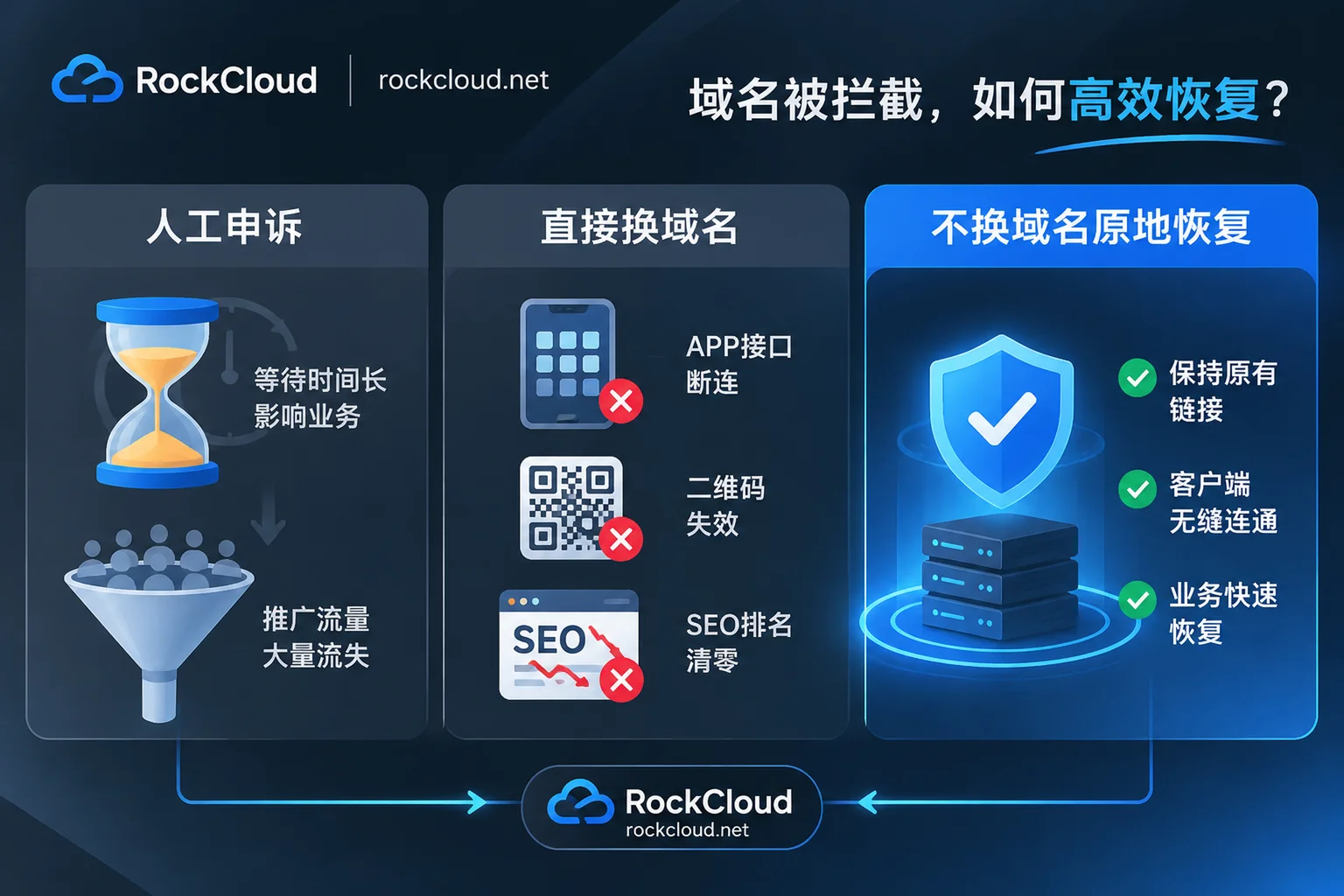
1. Manual Appeals: Long Cycles and Many Uncontrollable Factors
Whether submitting a webmaster verification appeal to a social platform or verifying resolution anomalies with regional ISPs, the standard process usually involves multiple steps such as "self-check and troubleshooting—preparing ownership and qualification documents—deploying verification files—manual queue review":
- Loss of the golden traffic window: During major promotions, live-streaming traffic campaigns, or new game launches, a link being unavailable for even a few hours means high user-acquisition budgets are wasted.
- Barriers for cross-border and non-ICP-filing businesses: Many businesses serving global users or using overseas architectures have not obtained a domestic ICP filing, or use second-hand domains with problematic histories, and are very likely to be rejected outright in regular appeal channels, falling into a vicious cycle of "repeated submissions and repeated failures."
- Regional misjudgments are hard to address one by one: Local DNS policy misjudgments or local provincial network blocking at the ISP level are often geographically scattered, making it difficult for enterprises to manually coordinate with each regional ISP to lift them.
2. Rough Domain Switching: Business Disruption That Affects Everything
Since appeals are slow, can you simply abandon the old domain and switch to a new one? This may work for purely static single-page showcase sites, but for mature businesses, changing domains is like performing high-risk "online surgery":
- Client and API disconnections: APP clients, mini-programs, desktop clients, or third-party payment callbacks often hard-code or bind the primary domain. Once forcibly changed, users who have not updated to the new client version will be completely cut off.
- SEO weight and existing backlinks reset to zero: Long-accumulated organic search rankings, overseas social media distribution links, and offline QR codes on materials will instantly become invalid.
- Ordinary 301 redirects fail under poisoning and interception: Many operations teams try to configure a regular Nginx 301 redirect on the old domain to the new domain. But if the old domain itself has already suffered DNS poisoning (returning a fake IP at the resolution stage) or social platform red-shield interception (the client blocks the request before it is even sent), user requests never reach your origin server, so regular 301 redirects naturally cannot take effect.
2. Why Are Many Domains Intercepted Again Right After Recovery or Switching?
In recent years of security operations practice, there is another high-frequency pain point that has puzzled countless operations teams: Why is a website intercepted by WeChat again or blocked by ISPs just a few days after going online, even though the content has been compliantly rectified or even moved to a brand-new clean domain?
After investigating a large number of cases, it becomes clear that what triggers the automated risk controls of social platforms and ISPs is often not only the page text content, but also security risks exposed by the underlying network architecture:
1. "Same-IP association" caused by origin IP exposure
Risk-control blacklist databases record not only domains but also build reputation profiles for server IPs. If a business directly resolves to the origin IP without protection, when the old domain is flagged as risky, that origin IP is often also placed under key monitoring. In this case, without hiding the origin and cleaning the link, even if you switch to a new domain that still resolves to the same origin IP, or share the same host IP with other violating sites, it is very easy to trigger associated risk controls and cause "instant blocking." For troubleshooting and closing off origin IP exposure, see "Will the Origin IP Still Be Exposed After Using a High-Defense CDN: Five Leak Paths, Closure Order, and Handling After Exposure".
2. Malicious traffic flooding and CC attacks trigger "anomalous propagation risk control"
The risk-control large models of social platforms and ISPs are extremely sensitive to access behavior. When a business encounters malicious competition from peers—for example, using large numbers of proxy IPs and automated scripts to launch high-frequency traffic flooding against your promotional links in a short time (CC attacks or malicious crawlers), or generating abnormal concurrent requests within a short period—it can easily trigger the platform's "temporary risk control for abnormal traffic" mechanism, causing normal domains to be automatically intercepted and blocked by the system.
3. Website vulnerabilities exploited to inject hidden links or malicious scripts
If the origin lacks effective Web Application Firewall (WAF) protection, attackers may exploit SQL injection, XSS cross-site scripting, or file inclusion vulnerabilities to plant gambling hidden links, phishing redirect code, or malicious scripts in obscure corners of web pages. Once detected by security scanning crawlers, the domain will immediately be labeled as "containing malicious fraud or Trojans" and blocked across the network.
3. RockCloud's Closed-Loop Domain Interception Recovery Solution: From "Emergency Unblocking" to "Long-Term Anti-Blocking"
To thoroughly escape the vicious cycle of "blocked—waiting for appeals/forced to change domains—blocked again," it is necessary to combine domain interception recovery with edge network security protection. RockCloud provides a full-link recovery and hardening architecture that requires no domain change, covering business scenarios such as websites, APPs, APIs, live streaming, payments, and AI services.
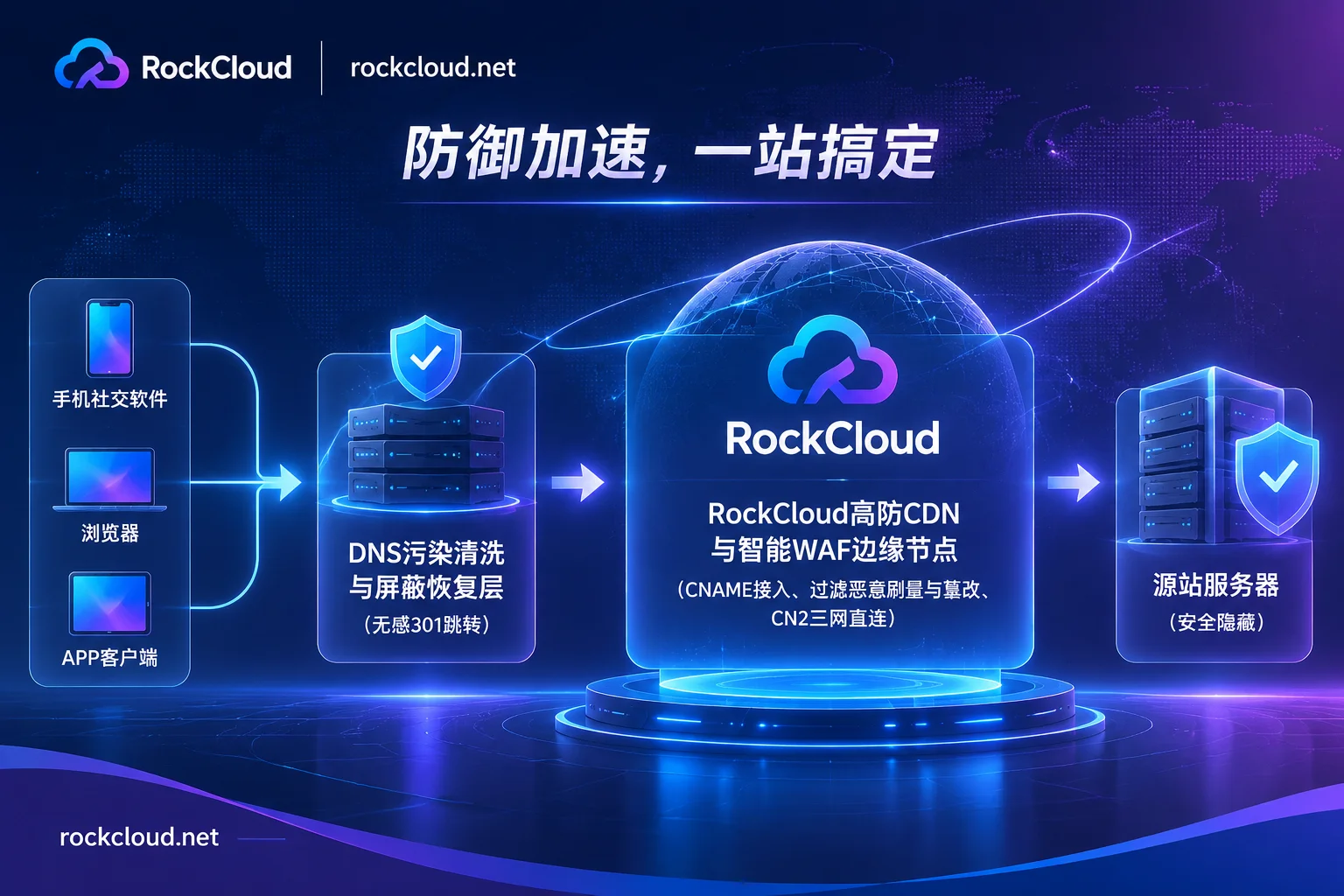
Step 1: Specialized Blocking and Poisoning Recovery for In-Place Revival Without Changing the Domain
For core domains that are already experiencing access anomalies, RockCloud provides a dedicated blocking and poisoning recovery service to directly solve the immediate problem:
- DNS poisoning cleanup: For domains returning incorrect IPs at the resolution layer or experiencing cross-border resolution anomalies, specialized poisoning cleanup technology repairs the resolution link, allowing users across the country and overseas to obtain the correct access node addresses again.
- Platform and regional ISP interception recovery: For link interception by social platforms such as WeChat and QQ, as well as blocking by ISPs in specific regions, we provide in-place recovery solutions without changing the domain, preserving existing client API endpoints, SEO weight, and backlink assets.
- Seamless 301 redirects: In scenarios requiring traffic distribution or specific landing page scheduling, smooth seamless 301 redirects can be implemented at the edge, avoiding the failure of traditional origin redirects due to front-end interception.
Step 2: CNAME Access to High-Defense CDN + CN2 China Backbone for Origin Hiding and Speedup
After the domain resumes normal access, the origin IP must never be directly exposed to the public internet again. By connecting to RockCloud High-Defense CDN and DDoS/CC Protection, associated blocking risks can be cut off at the architecture level:
- No NS changes, smooth parallel switching: Simply add a CNAME record at your original DNS provider to connect, with no need to modify the domain's NS servers. During the switch, old and new links run in parallel with zero business interruption. For detailed operation steps, see "Why CDN Without ICP Filing Is Often Slow for Domestic Access: Return Routes, High-Defense Cleanup, and NS-Free Access Solutions".
- Anycast distributed cleanup and origin hiding: After access, the entire network only sees RockCloud distributed edge node IPs, and the real origin IP is completely hidden. Combined with an origin firewall policy that only allows back-to-origin nodes, this completely eliminates associated blocking caused by origin IP exposure or direct DDoS extortion against the origin.
- ICP-filing-free three-network direct connection acceleration: For businesses with servers deployed overseas or in Hong Kong but needing to serve mainland Chinese users, CN2 China Acceleration can be added. Access is provided from China-surrounding nodes such as Hong Kong, Japan, South Korea, and Singapore, returning to mainland China via China Telecom CN2 GIA, China Unicom AS9929, and China Mobile CMI three-network direct connections. This delivers low-latency, highly stable access without ICP filing and eliminates resolution timeouts and misjudgments caused by cross-border link jitter.
Step 3: One-Click Intelligent WAF and Fully Automated SSL to Eliminate the Causes of Repeat Interception
To prevent malicious peer traffic flooding, crawler probing, and web page tampering from triggering platform red-shield interception again, deep cleanup must be completed before traffic reaches the origin:
- Block malicious tampering and vulnerability exploitation: Enable the Intelligent WEB Application Firewall (WAF) with one click in the control panel. Based on the OWASP core rule set, it precisely blocks SQL injection, XSS, file inclusion, command injection, and malicious script uploads, eliminating website defacement or injection of violating hidden links at the root.
- Clean abnormal traffic flooding and malicious bots: Use machine learning models to identify new malicious requests, scanners, and automated bots not yet included in rule libraries, working in coordination with DDoS/CC protection on the same request path. If fine-grained anti-flooding is needed for login, payment, or promotional APIs, RockCloud's security technical team can assist in configuring custom rules and exceptions (see "How to Do Bot Management: When AI Crawlers and Automated Scripts Flood Login and Payment APIs, How to Use Edge WAF for Fine-Grained Traffic Control").
- Strengthen transport-layer trust: Use the free fully automated SSL certificates in General Features to achieve full-link HTTPS encryption. Combined with security tokens, signed URLs, IP and region black/white lists, and anti-hotlinking policies, this prevents plaintext HTTP from being hijacked and tampered with by ISP man-in-the-middle attacks during transmission, while also greatly improving the domain's compliance trust score across major security engines.
4. Recovery and Protection Checklists for Different Business Scenarios
Different types of businesses have different affected links and recovery priorities when encountering domain interception. You can use the table below to quickly plan your access solution (for more vertical scenario architectures, see Solutions by Industry):
| Business Type | Core Pain Point After Interception | Recommended Combination | Key Benefits |
|---|---|---|---|
| H5 Marketing / Private Traffic / E-commerce Websites | Opening in WeChat/QQ shows a red exclamation mark or stops access, and promotional campaigns instantly drop to zero | Blocking and Poisoning Recovery + Intelligent WAF + Free Fully Automated SSL | In-place access recovery without changing promotional links; prevents malicious peer traffic flooding, reporting, and website defacement |
| APP / WEB API / Payment Callbacks | Regional ISP blocking or DNS poisoning causes client request timeouts and login/payment failures | Blocking and Poisoning Recovery (DNS poisoning cleanup) + High-Defense CDN | No client release needed; retain the original API domain; hide the origin to prevent CC API flooding |
| Cross-Border Business / Sites Without ICP Filing / AI Services | Unstable return links from overseas origins to China, compounded by DNS poisoning causing widespread inaccessibility in China | Blocking and Poisoning Recovery + CN2 China Acceleration | Quickly restore domestic access without ICP filing; three-network direct connections reduce packet loss during peak hours |
| Online Live Streaming / Short Video Distribution | Playback domains hijacked or poisoned, causing video buffering, while also facing bandwidth theft risks | Blocking and Poisoning Recovery + Video CDN / Anti-Hotlinking + Security Tokens | Restore the playback link, lock down pirated streaming requests, and ensure smooth high-concurrency distribution |
In terms of cost and operations management, RockCloud's basic plans are billed monthly by fixed peak capacity by default, with unlimited traffic and requests. Acceleration and protection are integrated into the same link and the same plan (including DDoS/CC protection, WAF, and SSL), with no need to separately piece together purchases. For customers with cross-border China return and unblocking needs, CN2 mainland acceleration dedicated lines and anti-hijacking/blocking recovery can be flexibly added on demand (see Billing Description). Meanwhile, the control panel supports batch operations for multiple domains and real-time Telegram data push, allowing operations teams to monitor domain health at any time.
Conclusion: Don't Let Domain Interception Cut Off Your Business Lifeline
When a core domain encounters DNS poisoning, ISP blocking, or social platform interception, passively waiting for manual appeals or blindly and frequently changing domains often drags the business deeper into traffic loss. The truly robust approach is to use professional technical means to achieve in-place recovery without changing the domain, while simultaneously incorporating the business into a closed-loop protection system of "high-defense CDN to hide the origin + intelligent WAF to filter abnormal requests + encrypted transmission."
If your business domain is currently facing an emergency such as resolution poisoning, regional inaccessibility, or platform interception, or if you want to build a highly available network architecture with anti-hijacking and anti-blocking protection in advance for critical businesses, please visit the Blocking and Poisoning Recovery page for details, or contact the security response team directly through the Contact page and the official Telegram (@rockclouds) to confirm business specifications and apply for testing, getting your business back on track as quickly as possible.