RockCloud-基石云安全-官方博客
In daily security operations, many technical leaders encounter a tricky situation: the server's inbound bandwidth usage is not high, the overall QPS on the monitoring panel does not show an exaggerated peak, but the backend database connection pool is instantly exhausted, CPU spikes to 100%, and normal users frequently encounter errors and timeouts when clicking login, search, or submit order on the APP or web page.
This is precisely the new type of application-layer attack that has evolved rapidly in recent years—a targeted CC attack against APIs and core dynamic interfaces. With the increasing automation of attack tools and the proliferation of residential proxy networks, traditional "single IP threshold rate limiting" and "site-wide five-second shield pop-up" are not only increasingly difficult to block attacks, but also tend to cut off normal business traffic.
This article starts from the real attack methods currently faced by dynamic interfaces and outlines a practical CC defense approach that does not harm normal user experience while protecting origin server computing power and budget.
I. Why is it increasingly difficult to block current CC attacks with "rate limiting"?
In the early days, when we determined whether a website was suffering from DDoS or CC attacks, we often looked at logs to see if certain IPs were frantically flooding requests. However, according to recent threat observation reports from major security institutions (such as the 2026 annual security threat research released by NSFOCUS and Akamai), the tactics of application-layer CC attacks have undergone three obvious shifts:
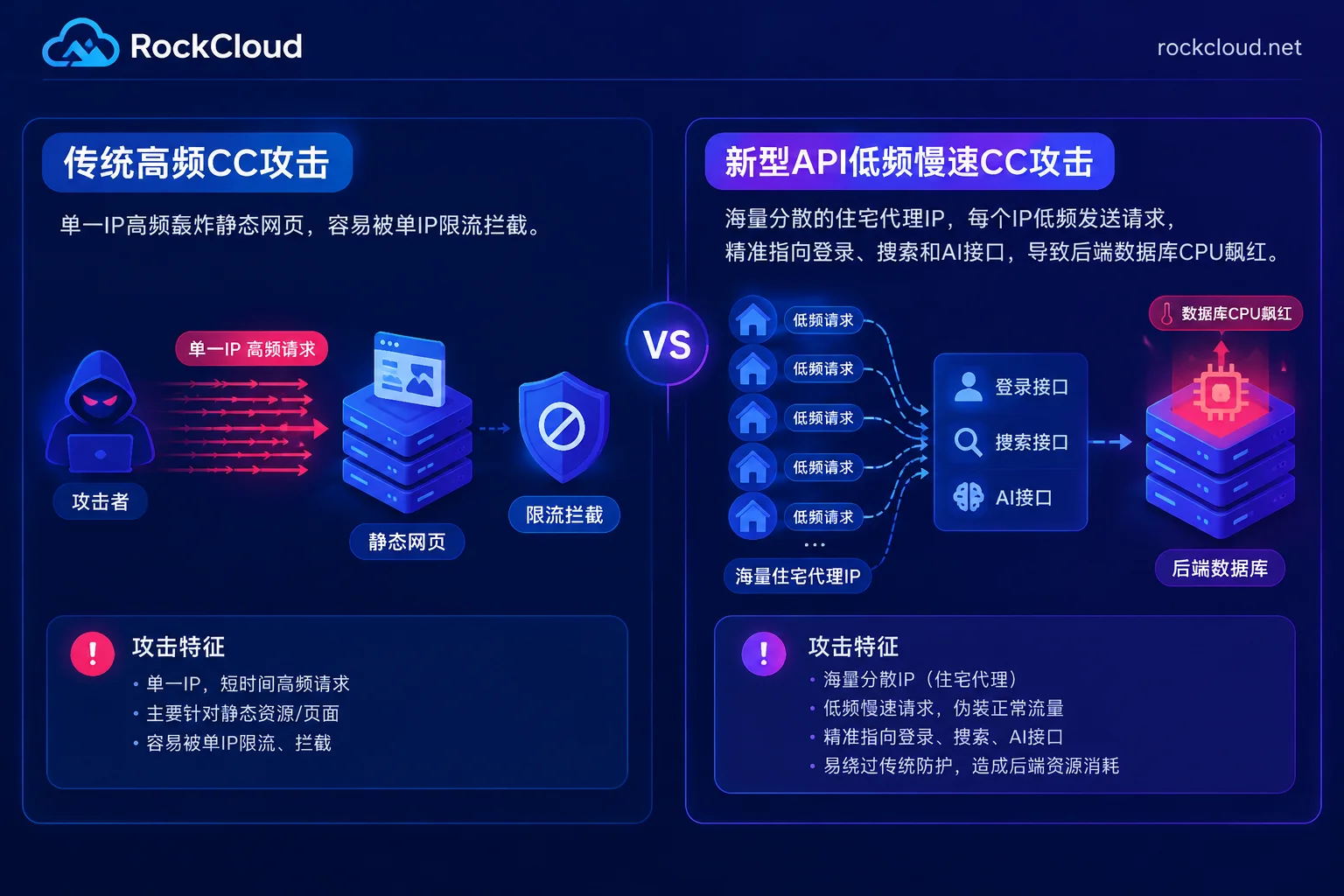
- Massive residential proxies combined with "low-frequency slow" requests: Attackers no longer use easily identifiable data center blacklisted IPs, but instead call real home broadband proxies (residential IPs) distributed around the world. Each IP only initiates a few requests per minute; the access frequency of any single IP looks very much like a normal user, directly bypassing single-IP rate limiting strategies based on static thresholds.
- Specially targeting "heavy computation, heavy query" API interfaces: Attack traffic no longer blindly bombards static pages such as website homepages, but precisely targets
/api/login(login authentication),/api/search(multi-condition fuzzy search), payment callbacks, and AI model inference interfaces. The frontend sends a legitimate request of only a few hundred bytes, but the origin backend must execute complex database join queries or computing power calls, achieving a paralysis effect with "four ounces defeating a thousand pounds." - Highly realistic protocol and request header characteristics: Requests generated by automation tools come with legitimate User-Agent, Referer, and even complete TLS handshake characteristics. If the business side mainly relies on APP or mini-programs communicating with backend APIs in JSON format, traditional web-side JS challenges (such as pop-up click verification codes) will cause the client to fail to parse the response, directly causing widespread disconnection of APP-side interfaces.
II. Four Core Dimensions of CC Defense for APIs and Dynamic Businesses
Faced with this kind of "low-frequency, distributed, core-interface-targeted" attack, simply tuning down limit_req parameters on the origin Nginx is useless. An effective defense architecture needs to strip malicious requests at the network edge. Specifically, the defense line can be built from the following four levels:
1. Combine rule baselines with machine learning to replace single static thresholds
Previously, when studying whether high-defense CDN can prevent CC attacks, everyone focused on whether edge nodes could withstand high concurrency; but in API scenarios, the more critical question is whether the WAF (Web Application Firewall) can "understand" request anomalies.
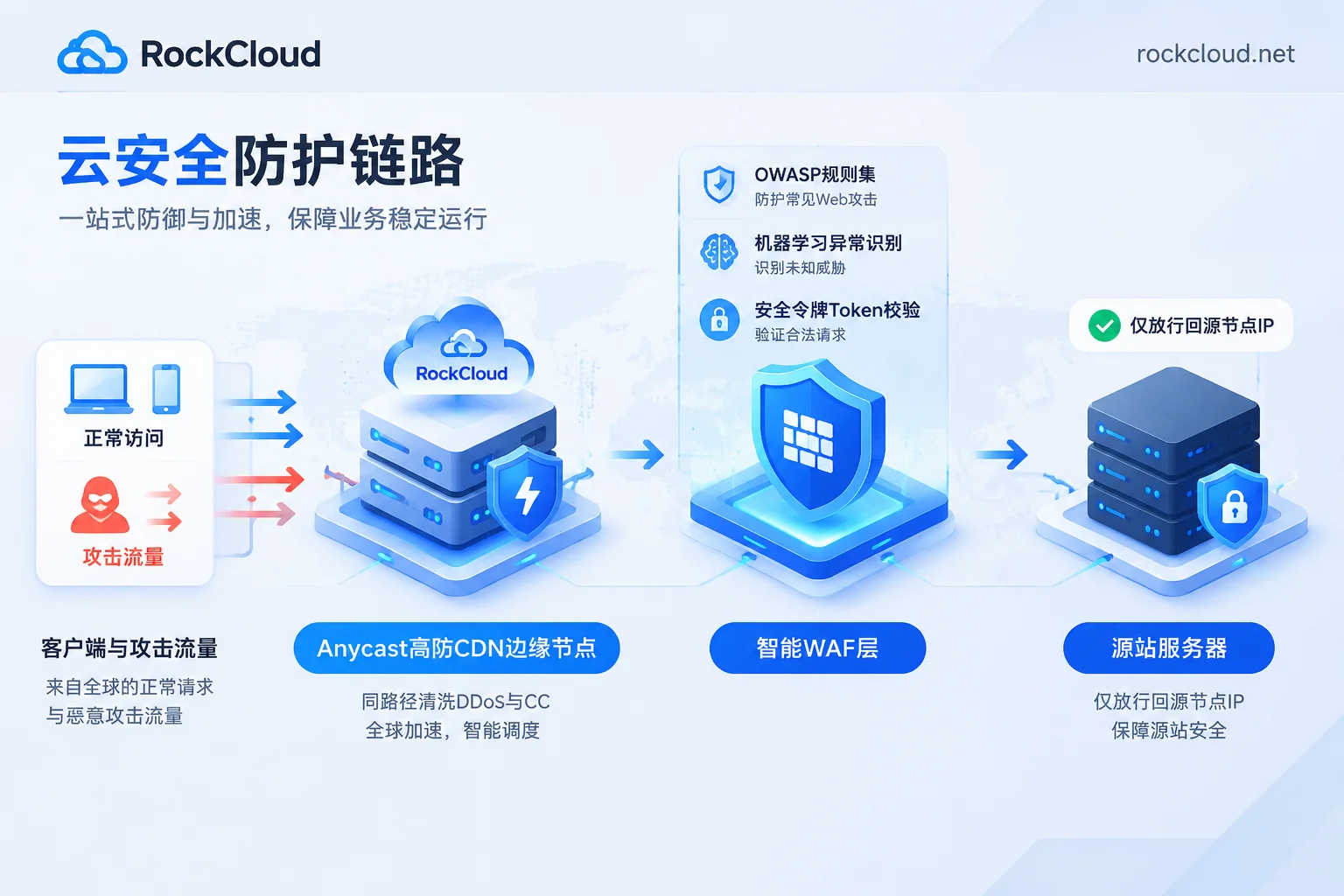
After integrating RockCloud Intelligent WEB Firewall (WAF), protection works simultaneously on two levels: the first layer uses the OWASP core rule set to directly block scanners, bot characteristics, malicious scripts, and known attack payloads such as SQL injection, XSS, and command injection mixed in CC traffic; the second layer uses machine learning models to analyze business traffic and identify malicious requests that are not yet covered by the rule set, have low single-IP frequency, but exhibit highly coordinated anomalies at the global level.
More importantly, for business paths such as APP interfaces and third-party payment callbacks that cannot arbitrarily trigger web verification codes, RockCloud's security technical team can assist in configuring custom rules and exception allow policies to prevent enterprises from blindly tuning and causing normal clients to be mistakenly blocked.
2. Lock down core interfaces with "security tokens" and access control
For high-value dynamic interfaces or audio/video streaming addresses, the most computing-efficient CC defense method is "discard at the edge if unauthorized." Rather than letting requests penetrate to the backend to query the database for identity verification, it is better to move verification forward to the CDN edge nodes.
By configuring security tokens (Token) and signed URLs in RockCloud's General Security and Protection Features, clients must carry signature parameters generated by a specific algorithm and time window when initiating requests. Edge nodes verify the signature validity immediately upon receiving the request—any unsigned requests forged by attack scripts, expired, or batch-replayed will be directly blocked at the edge and will not generate any origin requests. Combined with hotlink protection and IP and region black/white lists (for example, if a business only serves a specific country or region, directly block proxy pool access from non-business regions), more than half of invalid background traffic can be instantly eliminated.
3. Beware of "composite attacks" and CC variants at the TCP protocol layer
In actual offense and defense, attackers rarely use a single method. When they find that application-layer slow CC does not kill the target, they often immediately stack hundreds of Gbps of network-layer SYN/ACK Flood or UDP flooding, attempting to directly saturate the bandwidth of protection nodes or trigger data center blackholing.
Therefore, application-layer defense cannot be separated from underlying anti-DDoS. In RockCloud High-Defense CDN and DDoS/CC Defense Architecture, Anycast distributed scrubbing ensures that network-layer DDoS and application-layer CC defense are on the same request path, without the need to separately purchase and chain two sets of equipment. For businesses of different forms such as websites, APPs, WEB APIs, payments, and AI services, you can refer to the corresponding industry security acceleration solutions for integrated deployment.
In addition, if your business is not only HTTP/HTTPS interfaces but also includes many long-connection services using custom TCP/UDP protocols (such as board games, mobile games, or instant messaging), conventional Web CDN cannot parse connection-exhaustion attacks against proprietary protocols. In this case, you should use GameShield access, encapsulate non-HTTP protocols into private protocols, forward through distributed edge nodes and hide the origin server; once a node suffers a severe attack, the system will automatically switch to a high-defense node while keeping existing connections uninterrupted.
4. Calculate the economics of defense: avoid the "per-request billing" trap
Many enterprises find when reviewing CC attack losses that although the business survived with the cloud vendor's elastic protection, the bill received at the end of the month is staggering. This is because many cloud security products charge on a tiered basis by "number of requests (Queries)" or "origin traffic after scrubbing"—attackers use low-cost botnets to flood tens of billions of requests, equivalent to directly launching a "bill exhaustion attack" against the enterprise. This billing pain point was also highlighted in the previous Video CDN Anti-Leech and Anti-CC Selection.
To completely eliminate this concern, the RockCloud package billing model defaults to monthly billing based on fixed peak bandwidth, with unlimited traffic and unlimited requests. Acceleration and defense are integrated into the same package, including DDoS/CC defense, intelligent WAF, and free fully automatic SSL, with no need to pay extra sky-high bills for sudden massive malicious requests.
III. Access During an Ongoing Attack: How to Stop the Bleeding Quickly Without Exposing the Origin?
If your API or website is currently under a fierce CC attack and the server is already severely lagging, temporary code modification is obviously too late. When urgently mounting protection, it is recommended to strictly follow the three steps below to restore business as quickly as possible (for complete origin troubleshooting details, also refer to the Guide to Preventing Origin IP Exposure After High-Defense CDN Access):
- Quick CNAME access without changing NS: Directly modify the resolution record of the attacked domain at the original DNS provider, and add a CNAME pointing to the protection domain assigned by RockCloud. There is no need to change the domain's NS server, and the old and new links can smoothly run in parallel during the switch.
- Simultaneously change the origin IP and close the firewall: As long as you access during an attack, it means the old origin IP has most likely been exposed in the attacker's target library. While hiding the origin IP with high-defense CDN, be sure to contact the hosting provider to change to a new origin IP, and set the origin firewall (or security group) to only allow RockCloud origin node IP ranges, completely blocking the path for attackers to bypass the CDN and directly hit the origin.
- Enable real-time monitoring and alert push: After enabling WAF with one click on the control panel, you can observe the blocking effect through the panel's built-in traffic and bandwidth reports and network logs, and bind Telegram real-time data push to grasp business traffic fluctuations on your mobile phone at any time.
Faced with industrialized, automated new CC attacks, passive defense and temporary IP blocking will only make the operations team exhausted. If you are evaluating a long-term anti-attack and acceleration solution, welcome to visit the official website to learn about comparison with traditional high-defense and mainstream cloud vendors, or directly contact customer service to apply for a free test; if your business is under attack and needs emergency rescue, please immediately contact the RockCloud Security Response Contact Channel or the official Telegram (@rockclouds) for real-time assistance from the technical team.