RockCloud-基石云安全-官方博客
For websites, apps, APIs, games, and cross-border businesses that deploy servers or cloud hosts in Hong Kong, Japan, Singapore, Europe, or the US, the first time they choose a no-ICP CDN, teams usually care about "skipping the cumbersome ICP filing process, launching quickly," and basic free or low-cost plans.
However, once the business reaches a certain scale, many technical leads, ops engineers, and procurement staff find themselves preparing to switch to a second no-ICP CDN. The reasons for a second selection are usually very concrete: mainland customers repeatedly complain about page stalls during evening peak; when DDoS and CC attacks hit, login and payment APIs time out together; after enabling protection, normal client requests are frequently misblocked; or at the end of the month, traffic and request bills far exceed expectations.
If you are evaluating a replacement for your current no-ICP CDN, you should not look only at node count or base monthly fee. You need to re-examine the provider's underlying capabilities across four core dimensions: return-to-China link quality, precise application-layer defense, billing certainty, and seamless migration.
1. Why does the first no-ICP CDN become a poor fit over time?
In many recent business migration consultations, the pitfalls that teams past the beginner stage have hit with no-ICP CDNs are mainly concentrated in the following four scenarios:
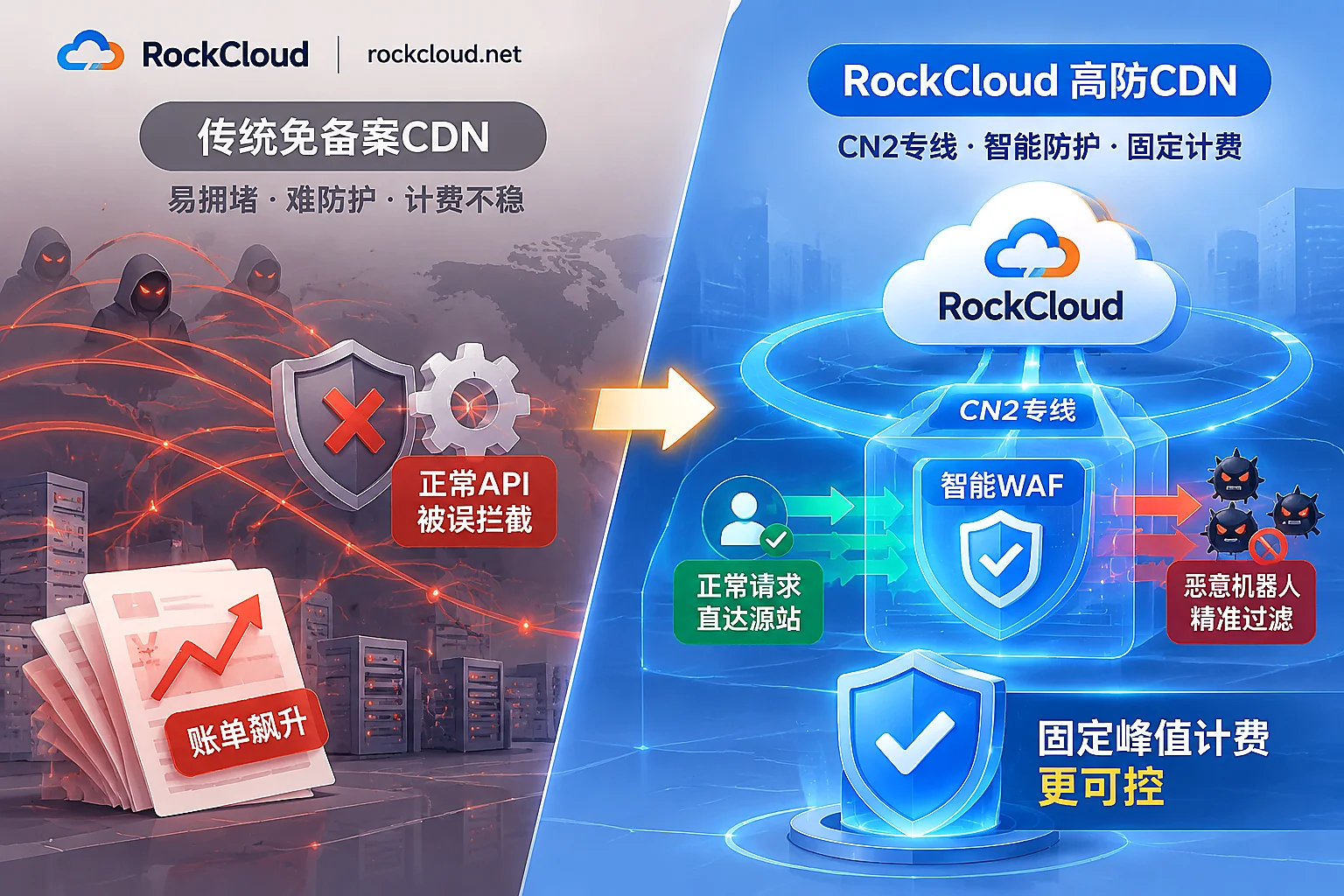
- Ordinary international BGP lines cannot withstand mainland evening peak: Many general-purpose overseas CDNs have numerous global nodes but lack dedicated optimization for the mainland China direction. Latency may look acceptable during daytime tests, but once backbone egress congestion hits in the evening, packet loss spikes, causing white screens and audio/video stalls. For the underlying causes of link quality, see our previous analysis Why domestic access to no-ICP CDNs is often slow: return routes, high-defense scrubbing, and NS-free access solutions.
- One-size-fits-all attack mitigation kills normal business APIs: When the business suffers CC attacks or crawler abuse of APIs, some CDNs can only rely on simple rate limiting or forced five-second shield CAPTCHAs. As a result, apps, APIs, WebHooks, and payment callbacks are widely misblocked. The attack does not take down the origin, but the defense policy locks down the business first.
- "Bill shock" after attacks or sudden traffic spikes: Many overseas CDNs bill by traffic (GB) or request count, and DDoS protection and WAF rule counts must be purchased separately. Once a burst attack or malicious abuse occurs, not only may service degrade, but at the end of the month you may face an unbearable variable bill.
- No solution for sudden domain pollution and social platform blocking: During operations, no-ICP businesses occasionally encounter DNS pollution from carriers in some regions, or blocking prompts when links are opened in WeChat, QQ, and other social platforms. Ordinary CDNs only handle caching and distribution and do not have pollution scrubbing or block recovery capabilities, forcing businesses to frequently change primary domains and lose existing users.
2. Four hard criteria for second-selecting a no-ICP CDN
To avoid "switching to another provider and falling into the same pit," when comparing new no-ICP high-defense CDN options, it is recommended to verify technology and commercial terms against the following four standards (you can also directly review the selection comparison between RockCloud and mainstream providers to understand architectural differences):
1. China-ring node layout and three-network direct-connect return lines
The premise of no-ICP is to deploy access nodes outside mainland China, but this does not mean sacrificing access speed for mainland users. An architecture truly optimized for Asia-Pacific and mainland visitors should access from nearby core China-ring nodes such as Hong Kong, Japan, South Korea, and Singapore, and use China Telecom CN2 GIA, China Unicom AS9929, and China Mobile CMI three-network direct-connect return lines at the cross-network transport layer.
In the RockCloud CN2 China Acceleration and Global CDN Acceleration architecture, user requests access the nearest node via Anycast, automatically select routes based on real-time latency, and connect directly to mainland China through a private backbone and CN2 dedicated lines. Combined with HTTP/3, TLS 1.3 0-RTT handshake optimization, Brotli compression, custom caching, origin retry, and backup origin rules, it legally and compliantly eliminates ICP filing procedures while ensuring low-latency responses for dynamic APIs and static resources during evening peak. If you want to further understand the underlying routing logic, you can read How to accelerate with CN2 lines: why a CN2 server alone is not enough, and why three-network direct connection plus high-defense CDN architecture is also needed.
2. Same-path DDoS/CC scrubbing and smart WAF with technical assistance
For mature businesses, acceleration and security absolutely cannot be separated. A superior no-ICP high-defense architecture must integrate acceleration, DDoS scrubbing, and CC defense into the same request path:
- Network-layer and transport-layer DDoS resistance: Anycast distributed scrubbing centers absorb attack traffic nearby. After access, the origin's real IP is completely hidden, preventing the origin cloud host from being blackholed by the data center due to traffic exceeding limits.
- Layer 7 smart WAF and false-positive prevention: In the RockCloud Smart Web Application Firewall (WAF), ops staff can enable protection with one click in the control panel. At the underlying level, the system uses OWASP core rule sets to block SQL injection, XSS, file inclusion, command injection, and malicious scanners, while machine learning identifies new malicious requests and mutated CC not yet covered by the rule library. More importantly, for complex login, payment, and third-party callback APIs, custom rules and exception allowlisting are configured directly with assistance from the security technical team, completely ending the dilemma of "when false positives occur, you can only wait on a ticket."
- Support for non-HTTP protocols and dedicated video scenarios: For game businesses that need TCP/UDP full-protocol forwarding, the Game Shield can encapsulate non-HTTP protocols into private protocols, forward them through distributed edge nodes, and switch to high-defense nodes within seconds during attacks while keeping connections alive. For streaming media businesses, you can directly use the Video CDN, which supports MP4/HLS/MPEG-DASH/CMAF playback, RTMP/RTSP and other push streams, secure tokens, and Multi-DRM content protection.
3. Fixed peak billing: unlimited traffic and unlimited requests
To completely eliminate financial budget uncertainty, second selection should prioritize providers with transparent billing and no hidden add-ons. Regarding the risks of pay-as-you-go billing, we broke this down in detail in What to do when a CDN is maliciously abused and DDoS attacks generate sky-high bills.
Under the RockCloud billing model, plans default to monthly billing, billed by fixed peak, with unlimited traffic and request counts. Acceleration and defense are included in the same plan and the same link. DDoS/CC defense, smart WAF, and free fully automated SSL certificates are all included, and defense does not need to be purchased separately (only CN2 mainland acceleration dedicated lines and anti-hijacking are billed separately on demand). Contract quotes are clear and support USDT or USD payment, so procurement and responsible staff do not need to worry about runaway bills when facing sudden traffic or malicious attacks.
4. Supporting domain pollution recovery and multi-cloud ecosystem collaboration
For common operational pain points of cross-border and no-ICP businesses, node caching alone is not enough:
- In-place recovery without changing domains: When encountering regional carrier blocking, DNS pollution, or WeChat/QQ domain blocking, Blocking and Pollution Recovery can perform DNS pollution scrubbing, block recovery, and seamless 301 redirects, avoiding frequent changes of promotional domains (see details in How to do domain blocking recovery).
- No-real-name account opening and top-up for origin cloud hosts: Customers can continue using existing servers as origins. If you need to scale overseas cloud hosts such as AWS, Azure, GCP, Alibaba Cloud International, Huawei Cloud International, or Tencent Cloud International, International Cloud Top-up provides free account opening, eliminating enterprise verification and cumbersome real-name procedures, supports USDT payment, and forms a complete loop with the front-end high-defense CDN.
3. How to switch to a new no-ICP CDN smoothly without business interruption?
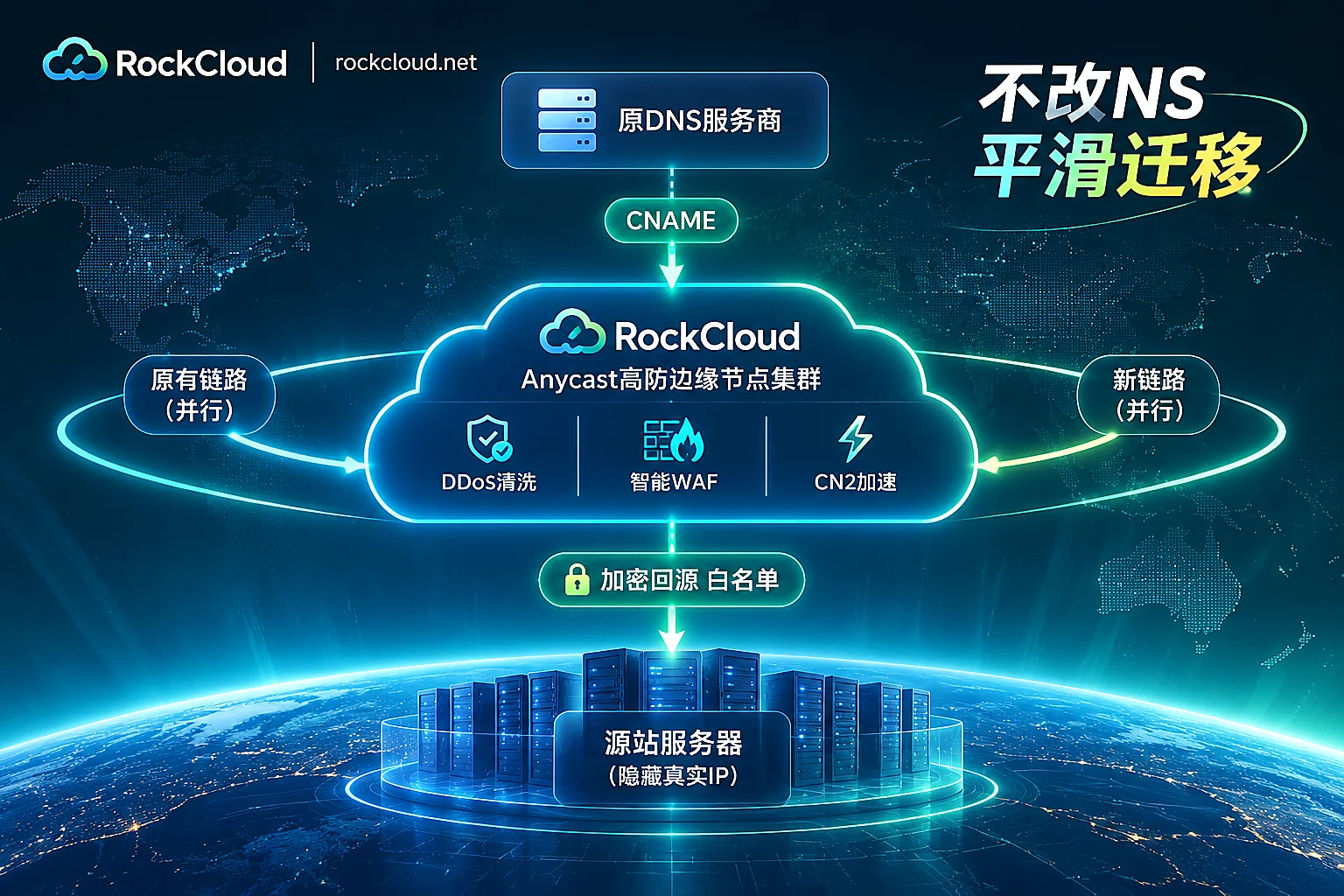
Many ops teams hesitate to change CDNs because the old provider requires changing the domain's NS (Name Server) records. Once NS is switched away, not only do complex resolution records on the original DNS provider need to be fully migrated, but global DNS propagation takes hours, easily causing business blips or resolution chaos during the switching window.
When accessing RockCloud High-Defense CDN, the mechanism used is the smoothest access mechanism for live businesses:
- Add only one CNAME, do not change NS: Your domain DNS remains managed at the original provider. You only need to modify or add one CNAME record in the original DNS panel to complete access. During the switch, old and new links can work in parallel, achieving true zero-downtime smooth migration.
- Control panel and efficient ops tooling: For teams with dozens or hundreds of domains, General Features provide multi-domain batch operations, API access, team member permission management, and a visual panel with traffic and bandwidth reports and network logs. It also supports real-time Telegram data push, so ops can monitor edge node status at any time.
- Emergency switching procedure when under attack: If your business is currently down because the original CDN has been breached and you need to migrate urgently while still under attack, then while completing CNAME access, be sure to simultaneously change the origin server IP and configure a whitelist on the origin firewall to allow only RockCloud return-node IPs. This cuts off the path for attackers to bypass the CDN and directly bombard the old origin IP (see details in Will the origin IP still be exposed after accessing a high-defense CDN?).
4. Conclusion: test and verify first, then replace with confidence
Second-selecting a no-ICP CDN is essentially an architecture upgrade from "good enough to launch" to "high availability, attack resistance, and controllable cost." Whether your business is a website, app, WEB API, live streaming, card game, IM, payment, AI service, short video, or WEB3 (you can check industry solutions as needed), you do not need to make a full cutover blindly.
RockCloud supports applying for a free test before formal replacement. You can first discuss your current business protocols, target visitor regions, and bandwidth scale with customer service, confirm the specifications, and then spin up a test link to verify return-to-China latency during evening peak, WAF rule compatibility, and origin return performance on the ground.
- For daily inquiries and free test applications: Please visit the Pricing and Plans page or confirm test specifications through the official website online customer service.
- If you are under attack and need emergency access immediately: Please go immediately to Contact Us (select "Security Response" for attack emergency handling) or contact the technical emergency team directly via Telegram: https://t.me/rockclouds.