RockCloud-基石云安全-官方博客
A regular CDN solves "speed"; a high-defense CDN solves "staying alive and fast under attack." Both can cache static files and distribute global traffic at the底层, but regular CDNs (including free CDNs) design their nodes for normal business traffic. When facing DDoS floods, high-frequency CC attacks, or automated API abuse, requests either penetrate directly and overwhelm the origin, or trigger high pay-as-you-go bills and even domain takedown by the provider. A high-defense CDN embeds Anycast distributed scrubbing, behavior identification, and WAF interception at the edge nodes, blocking malicious traffic before it reaches the origin. If your business is just a low-risk personal blog or a purely informational website, a regular CDN is sufficient; as soon as you have login transactions, API interfaces, game events, cross-border operations, or have experienced sudden slowdowns and traffic spikes, you should switch to a high-defense CDN.
Many people searching for "high-defense CDN" are already using a regular CDN from Alibaba Cloud or Tencent Cloud, or have a free Cloudflare layer, and are really wondering: Doesn't a regular CDN also cache, accelerate, and hide the origin IP? What exactly am I paying extra for with a high-defense CDN?
1. What's the Difference Between Regular CDN, Free CDN, and High-Defense CDN?
Putting all three solutions into the same business scenario table makes the differences obvious:
| Comparison Dimension | Free CDN (e.g., overseas free tier) | Regular Commercial CDN | High-Defense CDN |
|---|---|---|---|
| Core Positioning | Basic availability and lightweight static distribution | Static acceleration and reducing origin bandwidth | Integrated acceleration, distribution, and attack scrubbing |
| L3/L4 DDoS Protection | Only handles small routine traffic; large attacks easily degrade or rate-limit | No scrubbing or only basic thresholds; exceeding limits easily penetrates or blackholes | Edge distributed Anycast scrubbing; resists large volumetric floods |
| L7 CC and API Protection | Basic rules or aggressive global CAPTCHA (prone to false positives) | No protection by default or requires separate WAF component | Built-in CC behavior identification, rate limiting, and intelligent WAF |
| Dynamic Request Resilience | Passes through directly to origin | Passes through directly to origin; dynamic APIs easily exhaust CPU | First passes edge scrubbing and rule filtering; only clean requests reach origin |
| Billing Risk | Free tier has hidden limits on features and bandwidth | Billed by traffic/requests; abuse can lead to astronomical bills | Supports fixed peak billing; attack traffic not charged extra |
| Access Experience in Mainland China | No mainland line optimization; packet loss and timeouts during peak hours | Domestic nodes require ICP filing; without filing, only regular overseas lines | China-adjacent nodes without ICP filing can be paired with CN2 triple-network direct optimization |
| Manual Fallback During Incidents | No dedicated response; rule tuning all on you | Tickets focus on basic acceleration troubleshooting | Security team assists with custom rules, whitelisting false positives, and emergency response |
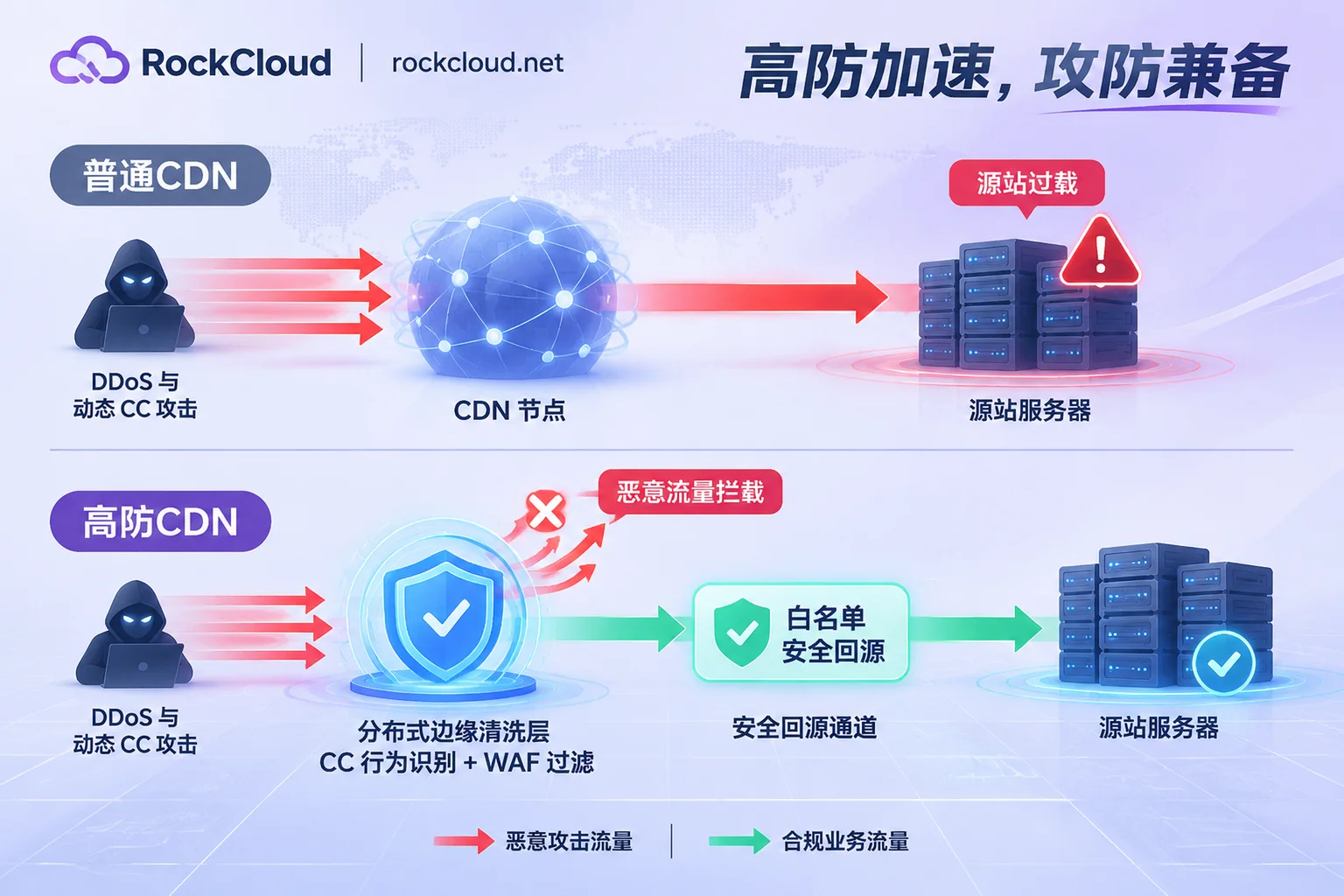
Architecturally, a regular CDN is like a pure "high-speed logistics fleet" that only delivers static goods like images, JS, and CSS to users. A high-defense CDN, however, sets up security checkpoints and blast gates at every transit station of that "high-speed logistics"—normal users take the green channel to fetch content nearby, while malformed packets, high-frequency CC scripts, and injection payloads are stripped at the edge. The origin only ever sees clean, compliant business requests.
2. Three Common Misconceptions: Why Does a Regular CDN "Seem Fine Normally but Fail Immediately When Trouble Hits"?
Misconception 1: "With a regular CDN, my origin IP is hidden and hackers can't reach me."
This is the most common and fatal illusion. A regular CDN does make public DNS resolve to node IPs, but if you haven't changed historical IPs that were exposed, haven't checked email headers and old subdomain records, or haven't configured your origin firewall to "only allow access from back-to-origin node IPs," attackers who obtain the real IP can bypass the CDN and hit the server directly. More commonly, even if the origin isn't exposed, regular CDN nodes themselves lack large-traffic scrubbing capability. Once an attack exceeds their capacity, some providers will suspend DNS resolution or force traffic back to origin to protect other tenants on the same node, instantly taking your business offline. For troubleshooting origin exposure, see Why Are You Still Getting Hit After Using a High-Defense CDN? Deconstructing Origin IP Leak Paths and Anti-Bypass Back-to-Origin Architecture.
Misconception 2: "My site's images are all cached, so CC attacks can't bring it down."
Static caching only offloads static resources and images on the homepage. Attacks that truly exhaust server resources almost always target dynamic paths that cannot be cached—such as login, registration SMS, site search, product filtering, payment checkout, or AI chat APIs. A regular CDN can only pass such requests through to the origin unchanged. As long as thousands of fake requests flood in per second, the origin's PHP/Node processes, database connection pool, and CPU will be overwhelmed within tens of seconds. Moreover, if you use a regular CDN billed by traffic or requests, an attacker can download large files or send high-frequency requests all night, and the next day you may receive a bill far exceeding your monthly fee (see What to Do When CDN Is Maliciously Abused and DDoS Attacks Cause Astronomical Bills).
Misconception 3: "Using an overseas free CDN avoids ICP filing and still gives decent domestic speed."
Many site owners without ICP filing directly use overseas free CDNs. Overseas users during the day usually have no problem, but during mainland China's peak hours from 20:00 to 23:00, free lines lack optimized return paths for China Telecom, Unicom, and Mobile, leading to cross-border detours, severe packet loss, and even intermittent inaccessibility. Once targeted CC attacks occur, enabling strict verification mode will block normal visitors and search engine crawlers alike.
3. Self-Check List: Which One Should Your Business Use Now?
No need to listen to sales pitches full of specs; just match your business state against the three categories below:
1. Continue Using Regular or Free CDN
- Purely static informational websites, personal tech blogs, or internal test sites with no login, checkout, or high-frequency query APIs;
- Industry with almost no malicious competition and no history of port scanning or extortion;
- Even if the site goes down for several hours, it won't cause significant order loss or reputation damage.
2. If Any of the Following Signals Appear, Upgrade to High-Defense CDN Immediately
- You have core dynamic APIs: including login authentication, SMS verification, search, shopping cart, payment callbacks, or public APIs, and need to identify and block high-frequency bots and CC requests that mimic real users (for a breakdown of CC, DDoS high-defense, and WAF boundaries, see Should CC Defense Be Purchased Separately? Differences from DDoS High-Defense and WAF, and a Guide to Avoiding Pitfalls);
- You are in a high-profile or high-adversarial industry: such as e-commerce promotions, online payments, chess/card and game official sites and event pages, live streaming/VOD, AI service proxies, Web3, etc.;
- You need no ICP filing but value domestic access: your origin is in Hong Kong or overseas, but your core users are in mainland China; you can't use domestic ICP-filed CDNs, and you can't stand the peak-hour lag of regular overseas lines;
- You need a controllable fixed budget: you worry about malicious abuse with pay-as-you-go billing and want acceleration and protection bundled into a fixed monthly fee;
- Abnormal signs have already appeared: server CPU and memory are normal, but users frequently report inaccessibility or API timeouts, or logs suddenly show a large number of regular requests from scattered IPs.
3. Boundary Reminder: Two Situations a High-Defense CDN Cannot Solve
Before making a purchase decision, you must understand the limits of a high-defense CDN:
- Non-HTTP/HTTPS TCP/UDP full-protocol direct connections: for example, long connections for mobile/PC game battles or non-standard port communications cannot go through a web high-defense CDN directly; such businesses need a game shield that encapsulates and forwards private protocols;
- Business logic or code vulnerabilities in your own application: the WAF built into a high-defense CDN can block known and mutated attacks such as SQL injection, XSS, and command injection, but it cannot replace fixing authorization checks in your origin code (e.g., unauthorized access to others' orders).
4. How to Smoothly Switch to High-Defense CDN Without Changing NS or Stopping Service?
Many operations teams hesitate to switch from a regular CDN because they worry about "slow NS propagation, old users disconnecting, and WAF blocking payment callbacks with no one to help."
If you are looking for a solution that simultaneously addresses attack resilience, ICP-free cross-border speed, and controllable billing, you can directly consider RockCloud's High-Defense CDN:
- No NS change, zero-downtime switch with one CNAME: You don't need to migrate your domain's NS; keep DNS at your current provider and simply add a CNAME record to onboard. During the switch, old and new paths can transition in parallel to avoid global propagation fluctuations (for details, see Do You Need to Change NS When Using a High-Defense CDN?).
- Acceleration, scrubbing, and WAF in the same path: RockCloud integrates Anycast distributed DDoS scrubbing, CC protection, and an intelligent Web Application Firewall (WAF) into the same request path and the same package—no separate purchase for defense. In the panel, you can enable the WAF engine based on OWASP Core Rule Set and machine learning with one click. For payment callbacks or specific APIs that need fine-grained whitelisting, the security technical team can assist in configuring custom rules and exception whitelists to reduce false positives.
- No ICP filing needed while maintaining triple-network speed in mainland China: For overseas origins serving domestic users, RockCloud can be paired with CN2 China Acceleration, onboarding via edge nodes in Hong Kong, Japan, South Korea, Singapore, and other China-adjacent locations without ICP filing. It uses China Telecom CN2 GIA, China Unicom AS9929, and China Mobile CMI triple-network direct connections to improve the peak-hour packet loss issues of regular overseas CDNs.
- Fixed peak billing, no fear of astronomical bills from abuse: Packages are billed monthly by fixed peak by default, with unlimited traffic and requests. DDoS/CC protection, WAF, and fully automatic SSL are all included (see Pricing), suitable for teams that need to lock down security budgets long-term. Before formal purchase, you can also contact customer service to determine business specifications and apply for a free test.
One last practical reminder: If you are currently under attack and rushing to get a high-defense CDN, do not just change DNS resolution—you must also change your origin server IP at the same time, and configure your origin firewall to only allow CDN back-to-origin node IPs, completely closing the backdoor for attackers to bypass nodes and hit the origin directly. For emergency onboarding or assistance, you can contact us directly via the RockCloud Security Response Contact Page or Telegram (https://t.me/rockclouds).