 RockCloud-基石云安全-官方博客
In the daily operations of online competitive games, MMORPGs, and mobile games, network attacks have long evolved from occasional incidents into a constant threat to business continuity. Once a server is attacked, players face increased latency, matchmaking timeouts, or even mass disconnections (commonly known as "bombing the room"), directly leading to player churn and revenue loss.
Building a game DDoS protection system with high elasticity and low latency has become a core challenge for game SREs and security engineers.
Latest Trends in DDoS Attacks on the Gaming Industry: Massive Traffic and Precision Penetration
Global threat reports from multiple international security agencies indicate that the gaming industry has long been on the front lines of network attacks:
- Attack frequency and scale have both increased: The Cloudflare Radar Q4 2025 DDoS Threat Report shows that gaming and entertainment consistently rank among the top four most attacked industries globally, with new botnets like Aisuru frequently launching ultra-large-scale reflection floods and carpet-bombing attacks. Radware's 2026 Threat Report also indicates a year-over-year surge of over 160% in network-layer DDoS attacks.
- Application-layer (L7) attacks have become more targeted: According to Help Net Security and Akamai statistics for the gaming industry, HTTP/L7 DDoS attacks against gaming applications have grown by 94% in recent years. Attackers no longer rely solely on crude bandwidth saturation; instead, they target gaming login authentication, lobby matchmaking, and payment APIs with CC attacks that simulate legitimate player behavior during promotions, new season launches, or esports events.
- Protocol mixing and carpet-bombing: NETSCOUT threat research points out that attackers are widely adopting carpet-bombing strategies that send low-volume UDP/TCP traffic to multiple IPs within a network segment. This technique easily bypasses traditional single-IP bandwidth threshold alarms and can directly overwhelm the session tables of routers or firewalls in game data centers.
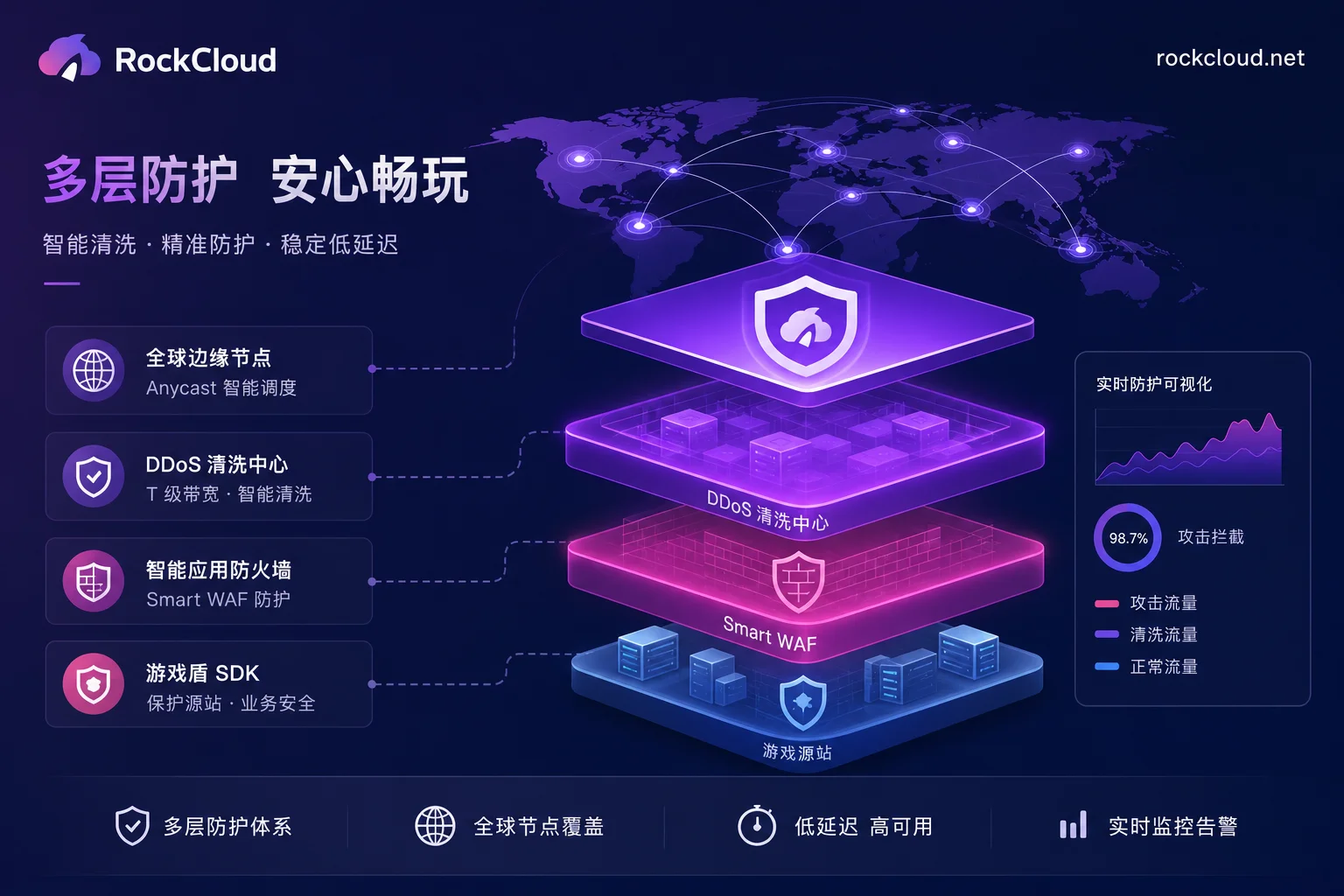
Game Business Sensitivity to DDoS/CC Attacks
Compared to traditional websites, defending games is more difficult due to the following dimensions:
- Extreme latency sensitivity: Competitive games require RTT (round-trip time) to remain in the millisecond range; any additional routing detours or scrubbing latency introduced by protection solutions will severely degrade the player experience.
- Mixed TCP/UDP protocol dependency: Game lobbies typically use HTTP/HTTPS/WebSocket, while real-time matches often use UDP/KCP protocols. Traditional high-defense Web solutions optimized only for HTTP are difficult to apply directly to real-time match services.
- Source server IPs are easily exposed: When a client establishes a game match connection by directly accessing a fixed server IP, attackers can easily capture packets to obtain the source IP and launch targeted attacks.
Layered Defense Architecture for Game DDoS Protection
In response to these challenges, modern game security protection must move beyond the "single-point resistance" mindset and establish a layered scrubbing architecture across the network, application, and client layers:
1. Traffic Layer (L3/L4): Anycast Nodes and Intelligent BGP Scrubbing
Deploy a high-defense network with Anycast architecture, utilizing multiple nodes distributed globally to absorb and scrub Tbps-level UDP/TCP floods and SYN floods in real time. By identifying the fingerprint characteristics of UDP/GRE packets at the edge layer, carpet-bombing traffic can be filtered directly, preventing massive traffic from entering the source server's data center.
2. Application Layer (L7): Intelligent WAF and CC Behavior Analysis
For game web authentication, payment, and login interfaces, introduce an intelligent WAF rule engine. Based on IP access frequency, CAPTCHA/JS challenges, and request context analysis, precisely intercept high-concurrency CC attacks to ensure the availability of critical APIs.
3. Client and Protocol Layer: Game Shield SDK for Dynamic Hiding
For matchmaking servers, adopt game shield SDK technology. By embedding an encrypted SDK into the game client, player connections are scheduled to dynamically distributed high-defense nodes, achieving complete concealment of the source server IP. Even if one node is attacked, the system can switch nodes in seconds, ensuring player sessions remain connected.
RockCloud's Practice in Game Security and Acceleration
As a platform focused on enterprise-grade security and infrastructure services, RockCloud provides game customers with one-stop capabilities covering network acceleration and comprehensive defense. In complex business scenarios, RockCloud publicly offers high-defense CDN, DDoS and CC protection, intelligent WAF, game shields, Anycast global network acceleration, CN2 China dedicated lines, caching and log services, as well as security rules and technical support for complex businesses.
In typical game deployment scenarios, for game official websites and API endpoints, RockCloud's high-defense CDN and intelligent WAF can be used for edge protection and application-layer scrubbing; for high-concurrency cross-border or cross-network matches, combining CN2 dedicated lines and Anycast networks can reduce transmission latency while enhancing the business's ability to withstand large-scale traffic impact.
Game Security Architecture Self-Assessment Table
For current game operations, operations teams can self-test security from the following dimensions:
| Assessment Dimension | Security Risk | Protection Countermeasure | RockCloud Capabilities |
|---|---|---|---|
| Source hiding | Source IP exposure through client package analysis or DNS leakage | Deploy dynamic node proxy and game shield SDK | Game shield / Anycast edge scrubbing |
| UDP match protection | Reflection floods targeting UDP ports used in matches | Filter based on packet fingerprint characteristics and protocol validation | DDoS protection / BGP high-defense servers |
| API CC attacks | Login/matchmaking interfaces overwhelmed by high-frequency requests | Implement token validation, dynamic rate limiting, and CAPTCHA | Intelligent WAF / high-defense CDN |
| Cross-border/cross-network latency | Scrubbing node detours causing significant latency increase | Choose acceleration nodes with dedicated lines and premium BGP | CN2 China dedicated lines / global network acceleration |
Practical Operational Checklist for Game Security
- Hide source server: Check all game subdomains and match ports to ensure source IPs are not exposed in public DNS records or client configuration files.
- Strict protocol validation: Enable TCP/UDP protocol legality checks at the access layer and directly discard malformed packets.
- Multi-line redundancy and rate limiting: Set reasonable rate limits and static caching policies for non-critical interfaces (e.g., in-game announcements, event pages).
- Emergency response drills: Regularly conduct traffic switching drills for large-scale DDoS and high-concurrency CC scenarios to ensure the security team can quickly activate protection strategies during sudden attacks.
In the fast-paced evolution of the gaming industry, combining professional high-defense infrastructure with sound architecture design is the only way to achieve "no player impact, no business interruption" in the face of complex DDoS threats.


Comments(0)