 RockCloud-基石云安全-官方博客
In the current cybersecurity landscape, traditional website DDoS protection strategies are facing unprecedented challenges. According to the 2026 cyber threat analysis reports released by Radware and Cloudflare, extremely high-throughput distributed denial-of-service attacks now exhibit three prominent characteristics: "short-duration bursts," "mixed L3/L4 and L7 penetration," and "AI-automated stress testing" 1. Many defense systems are overwhelmed or hung by pulse peaks before they can even detect traffic anomalies.
To counter modern attack patterns, efficient website protection can no longer rely on manual response or simple DNS polling to unblock. Instead, a deep defense architecture that combines "second-level edge scrubbing + application-layer logic authentication + complete source server concealment" must be established.
New DDoS Attack Trends in 2026 and Source Risk Analysis
1. Extremely Short Attack Duration with Extremely High Instant Traffic
Radware's security report for the first quarter of 2026 points out that Web DDoS attacks at Layer 3 and Layer 4 of the OSI model have surged, with the majority of high-impact Web DDoS bursts now lasting less than 60 seconds [1]. Cloudflare's monitoring of civil institutions and enterprise networks similarly indicates that most attacks are completed within 10 minutes 2. Attackers leverage DDoS-for-hire platforms to launch second-level high-pressure floods, aiming to break through business operations in the instant before the defense system can respond.
2. Significant Increase in the Proportion of L7 Application-Layer and API Attacks
Attacks targeting Layer 7 web applications and APIs have increased by more than 100% year-over-year [1]. Attackers use HTTPS Floods, abnormal TLS handshakes, and complex request fingerprints to masquerade as legitimate users, exhausting source server CPU and database connection pools. Such attacks do not necessarily require tens of Gbps of physical bandwidth; even a few hundred thousand RPS of precise requests can cripple web services.
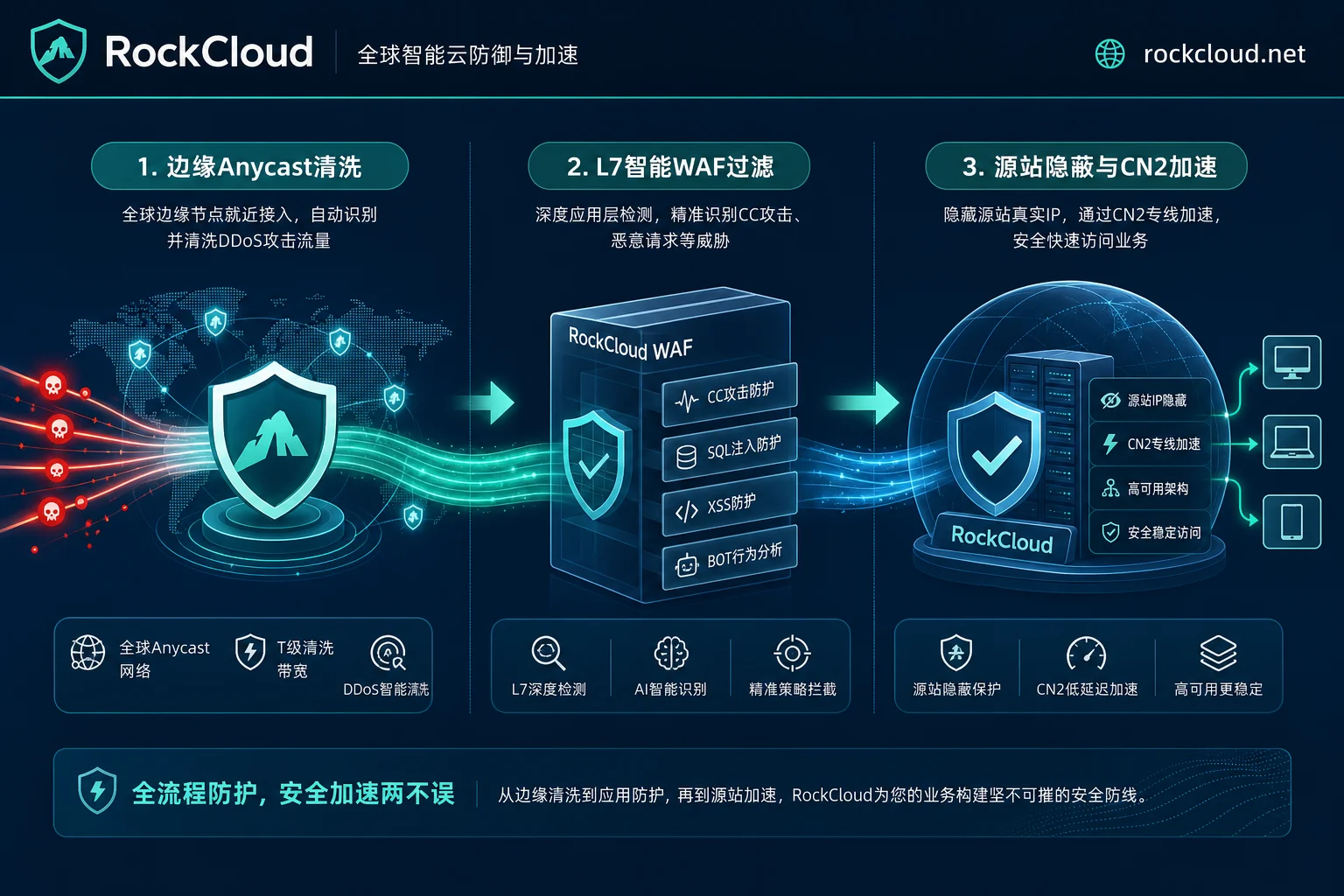
Layered Architecture Implementation Steps for 2026 Website DDoS Protection
To seamlessly resist ultra-large traffic and complex application-layer attacks, enterprise SRE and security engineers should refine their defenses in the following three steps:
Step 1: Deploy Edge Anycast Traffic Scrubbing and Diversion
Resolve and schedule the website domain to high-defense edge nodes with global Anycast capability. When TB-level UDP/TCP flood attacks occur, the edge network absorbs and discards traffic at the POP node closest to the attack source in real time, preventing large traffic from overwhelming the backbone network and the source server's uplink.
Step 2: Enable Application-Layer Intelligent WAF and Behavioral Fingerprint Verification
For encrypted HTTPS Floods and CC attacks, relying solely on IP-layer blocking is ineffective. The TLS handshake must be terminated at the edge node, and a combination of HTTP request headers, JA3/JA4 algorithm fingerprints, behavioral rate limiting, and intelligent CAPTCHAs should be used to distinguish human and bot traffic in real time, ensuring that dynamic interfaces (such as login, payment, and search) are not disrupted by malicious penetration.
Step 3: Achieve Absolute Source Concealment and Backup Link Convergence
Once attackers discover the real IP address of the source server, they will bypass all CDN and protection nodes to launch targeted strikes. Enterprises must:
- Restrict the source server firewall to allow access only from secure node IP ranges;
- Disable wildcard domains and email services that are directly exposed from the source server;
- Use private lines or reverse proxy tunnels to maintain high-speed connections between edge nodes and the source server.
Protection Selection and RockCloud's Layered Capability Support
When dealing with such high-frequency pulse and hybrid attacks, architects can leverage RockCloud's high-defense CDN and intelligent WAF to quickly build a protective barrier. By deploying automated scrubbing rules at the edge and combining them with cloud high-defense capabilities, most L3/L4 flood peaks can be instantly mitigated at the edge, while the intelligent WAF applies granular policy inspection to HTTPS traffic.
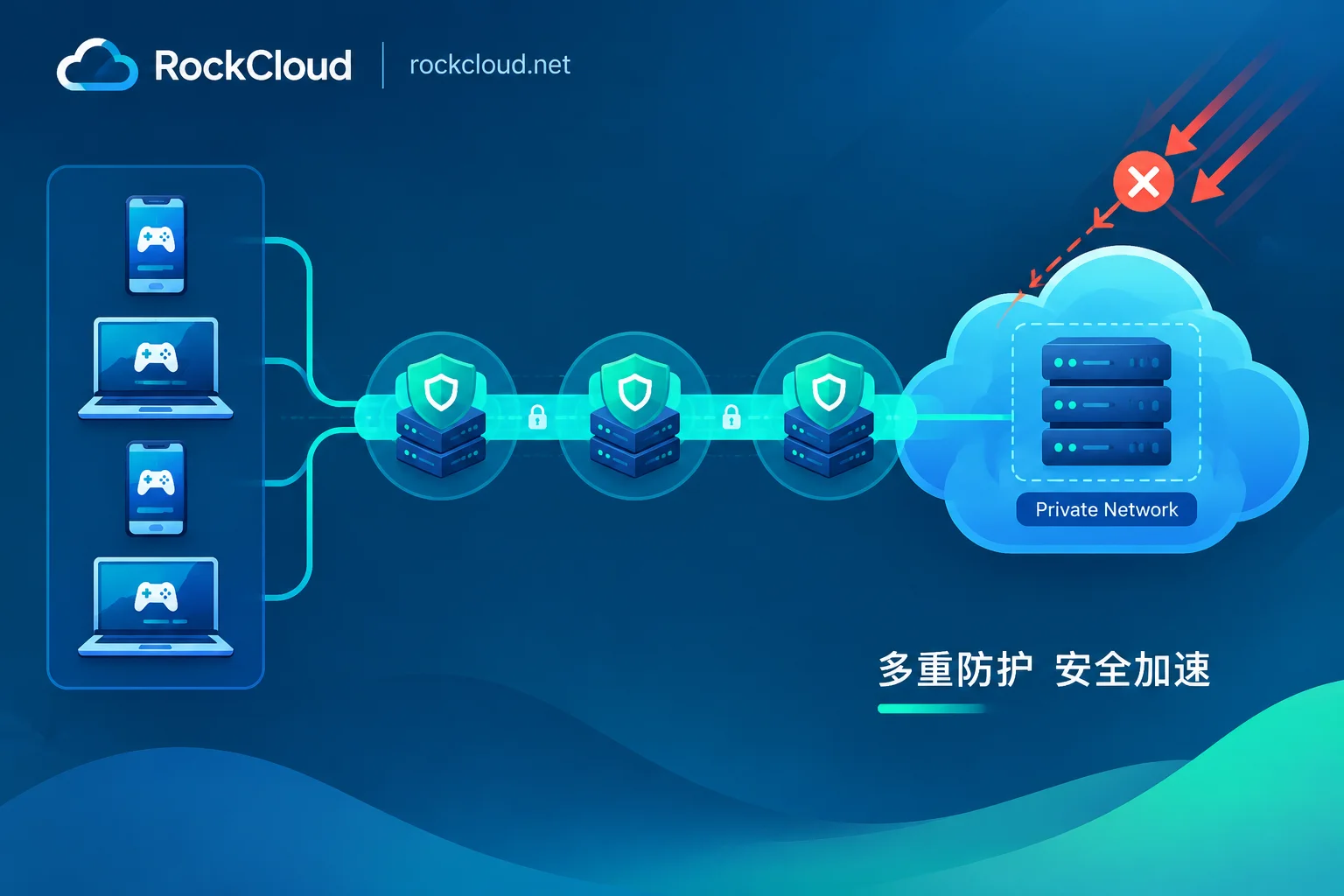
For businesses with specific ultra-low latency and anti-blocking requirements, RockCloud also offers Game Shield and CN2 China Direct Connect access solutions. While improving cross-border and cross-network transmission performance, it simultaneously achieves both network acceleration and security scrubbing, ensuring comprehensive business continuity.
Summary and Security Response Recommendations
With the proliferation of automated attacks and high-RPS algorithmic threats, passive "post-attack scrubbing" has proven insufficient to maintain business stability. It is recommended that enterprise security teams immediately perform the following checks:
- Evaluate Scrubbing Response Time: Test whether the existing protection system can identify and automatically block pulse attacks within 3 seconds.
- Conduct Source Concealment Audit: Check historical DNS resolution records, subdomains, and SSL certificates to see if the real IP of the source server has been leaked.
- Introduce Defense-in-Depth Capabilities: By deploying RockCloud's distributed scrubbing and source protection capabilities, liberate business bandwidth and computing resources from frequent attack/defense consumption, ensuring core business remains online at all times.



Comments(0)