 RockCloud-基石云安全-官方博客
When comparing CN2 GIA and CN2 GT line performance and latency, the only reliable criterion is to check which network the return route falls into: CN2 GIA uses China Telecom AS4809 (nodes starting with 59.43) end-to-end in both directions, while CN2 GT uses AS4809 only on the outbound segment, and the return route merges into the 163 backbone network (nodes starting with 202.97) after entering China. Therefore, a low ping during the day proves nothing; the real difference only emerges during the evening peak congestion window from 20:00-23:00. This article provides a four-step testing method you can use to verify yourself, without being misled by vendors' "full CN2" claims.
First, the conclusion: CN2 GIA vs CN2 GT performance and latency comparison boils down to one thing
Both CN2 GIA (Global Internet Access) and CN2 GT (Global Transit) use China Telecom's CN2 network, but GIA goes through the AS4809 dedicated channel end-to-end in both directions, while GT uses AS4809 only on the international segment, with the return route merging into the 163 backbone (AS4134). In one sentence: 去程看谁不难,回程看谁才准.
The difference is thus confined to a specific time window: during non-peak hours in the day, the 163 backbone has ample bandwidth, so latency for GT and GIA is almost identical; during the evening peak, 163 return congestion causes GT latency to spike, with obvious packet loss and jitter, while GIA maintains low latency thanks to its dedicated channel and highest QoS scheduling. So, "normal during the day but laggy at night" is often a typical symptom of GT.
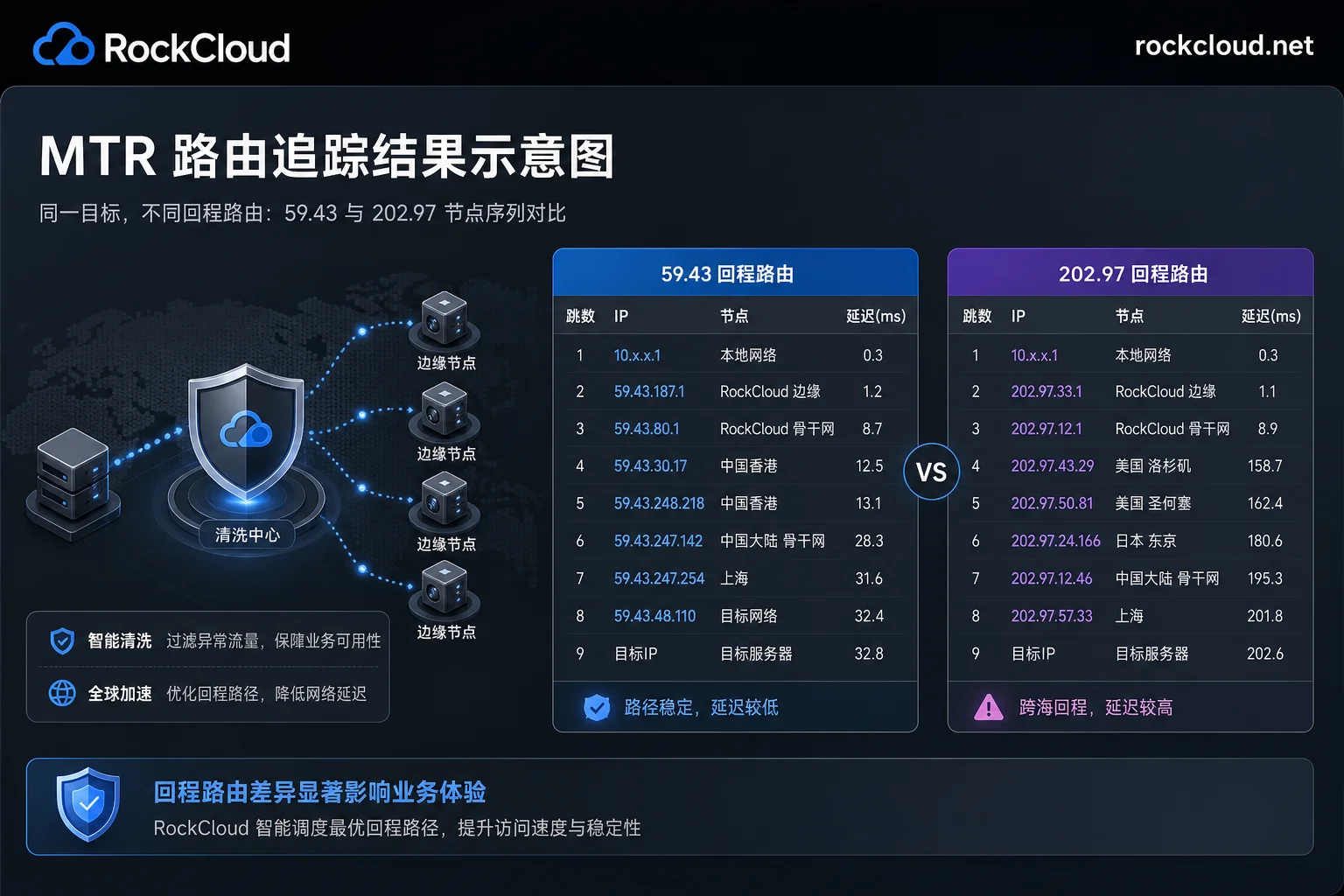
How to read route segments: the correspondence between 59.43, 202.97, and AS4809/AS4134
To read mtr output, just remember these two groups:
| Routing node prefix | ASN | Network | Typical characteristics |
|---|---|---|---|
| 59.43 | AS4809 | CN2 dedicated network | Light load, QoS priority |
| 202.97 | AS4134 | 163 backbone (public internet) | Carries massive traffic, prone to congestion in the evening peak |
The logic is simple: if the return route contains both 59.43 and 202.97, and the latter appears in the domestic segment, it is CN2 GT; if all nodes start with 59.43 and there is no 202.97, it is CN2 GIA. Note that occasional other IP segments in intermediate nodes are normal; the key is the ownership of the last few hops entering China.
Step 1: Capture bidirectional routes to distinguish the key hop between CN2 GIA and CN2 GT
Testing only the outbound route can be fooled by GT because GT's outbound route does go through CN2. You must capture both directions:
- Outbound route: From your local computer, run
mtr -rw <服务器IP>(on Windows usetracert) and observe the nodes from leaving the country to the server. If many 59.43 nodes appear, the outbound route uses CN2. - Return route: On the server, run
mtr -rw <你的本地IP>. Only if the return route is all 59.43 is it GIA; if 202.97 appears, it is GT.
If the server does not provide SSH or you cannot execute commands directly, use online monitoring tools from multiple domestic locations to reverse test, the principle is the same.
Step 2: Measure packet loss and jitter by time period to explain why latency is normal during the day but lags at night
During the day in non-peak hours, latency differences between GT and GIA are minimal and may even be indistinguishable. Therefore, testing must cover the evening peak (20:00-23:00) and sample continuously for at least 10 minutes, recording packet loss rate, jitter, and latency fluctuations.
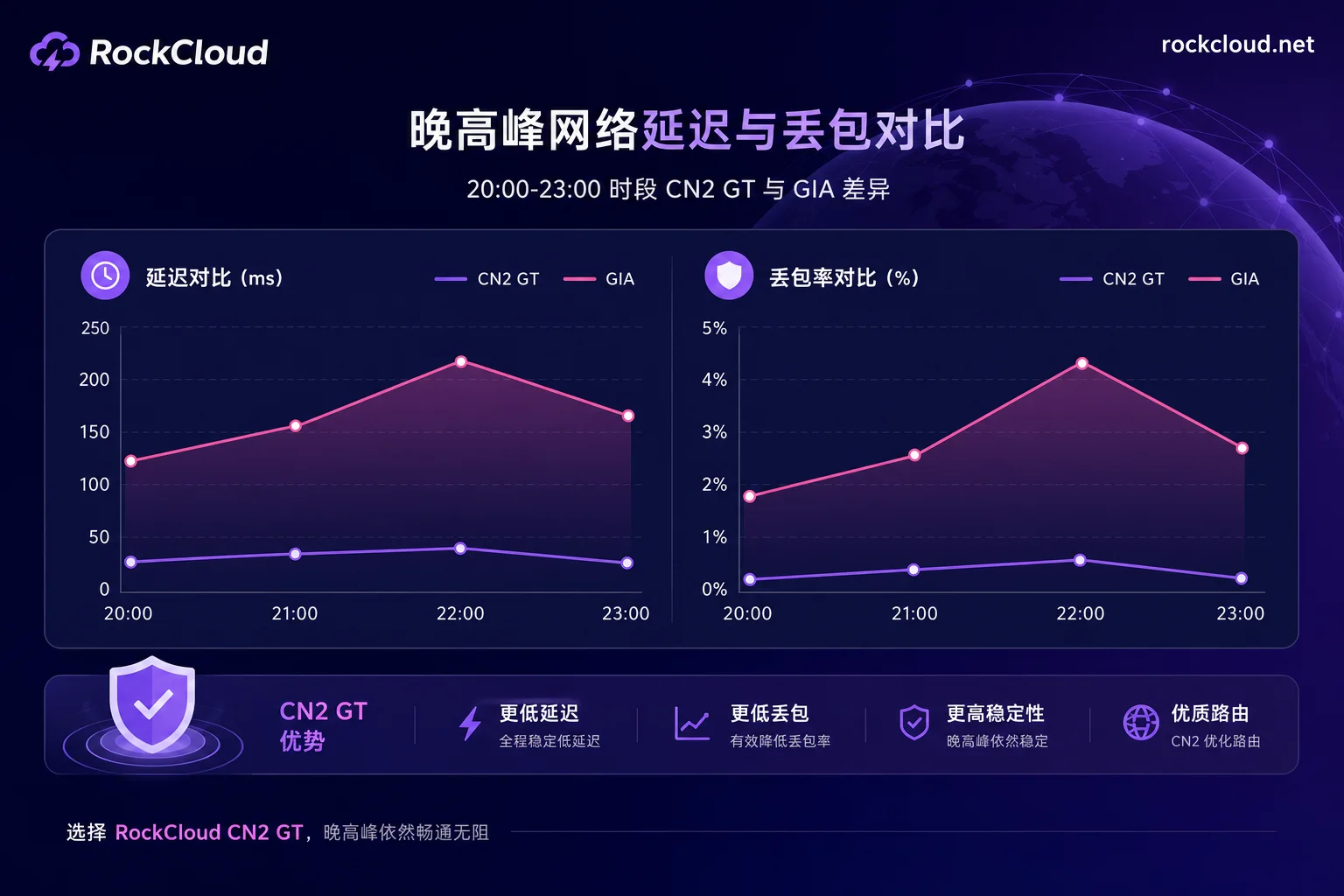
Record observations using the following table:
| Time period | Packet loss | Jitter | Latency fluctuation | Reference for judgment |
|---|---|---|---|---|
| Daytime (e.g., 10:00) | Very low | Very low | Stable | Cannot distinguish GIA/GT |
| Evening peak (e.g., 21:00) | GT may surge | GT increases significantly | GT fluctuates clearly | GIA remains stable |
If daytime and evening peak data are almost identical, the line quality is good, but it could also be GIA; only a significant deterioration during the evening peak indicates GT.
Step 3: Distinguish between international egress congestion and domestic segment congestion; don't misattribute the problem
After obtaining mtr per-hop data, look at where the packet loss starts:
- If packet loss starts only after entering the domestic (202.97 segment), it indicates 163 return congestion, which is typical of CN2 GT.
- If packet loss starts on the international segment (e.g., overseas transit), it may be an international egress or submarine cable issue, unrelated to line type.
- Also note that ICMP rate limiting on intermediate hops can cause "false packet loss"; check whether the last few hops recover, and don't be misled.
Remember: line acceleration and attack scrubbing are two different things. CN2 only guarantees transmission priority, it does not have DDoS filtering capability; large traffic attacks can saturate the upstream bandwidth and even trigger blackholing. If you need both cross-border access acceleration and anti-attack capability, you need to evaluate the acceleration link and edge scrubbing solutions separately, such as the architecture mentioned in BGP Anycast in DDoS mitigation.
Step 4: Retest and cross-validate with multiple nodes to rule out occasional jitter
A single test cannot be the basis for procurement. You must repeat steps 1-3 across multiple days, multiple ISPs (Telecom/Unicom/Mobile), and multiple regional nodes. Only a return route and congestion pattern that stably reproduce are trustworthy. If the 202.97 segment packet loss consistently reproduces at the same time over multiple days, it is strong evidence that the return route merges into the 163 backbone; ultimately, the ownership of the return route nodes determines the line type.
- If evening peak packet loss occurs on only one day, it may be a transient public network fault and does not constitute a judgment.
- If packet loss in the 202.97 segment occurs continuously at the same time over several days, it is strong evidence of return route merging into the 163 backbone.
- Also test from local networks of different ISPs to avoid interference from a single ISP's routing policy.
Four-step criteria comparison table and substandard signal quick reference
The four-step criteria for CN2 GIA vs CN2 GT performance and latency comparison are summarized below:
| Step | Observation | GIA expected performance | GT typical performance | Judgment action |
|---|---|---|---|---|
| Step 1 | Bidirectional route nodes | Return route all 59.43 | Return route shows 202.97 | Record node ownership |
| Step 2 | Evening peak packet loss and jitter | Maintains low jitter | Packet loss surge, obvious jitter | Sample over multiple days |
| Step 3 | Packet loss start point | No obvious congestion segment | Packet loss on domestic 202.97 segment | Locate congestion |
| Step 4 | Multi-node retest | High stability | Reproduces same issue | Cross-validate |
Substandard signal quick reference:
- Vendor claims "full CN2" but return route shows 202.97.
- Vendor does not provide a test IP or avoids bidirectional route verification.
- Daytime tests are normal, but they refuse to cooperate with evening peak testing.
If you are choosing a Hong Kong server, you can refer to How to choose a Hong Kong CN2 server and combine it with the methods in this article for verification.
Good line does not mean it can withstand attacks: the division of labor between acceleration and scrubbing
The CN2 dedicated line only solves transmission quality issues; it does not perform any DDoS/CC traffic scrubbing. When under a large traffic attack, the source site's upstream bandwidth will be saturated, and even with CN2 GIA, route blackholing may be triggered. Therefore, transmission quality and security protection are two decoupled design dimensions.
In actual architecture, acceleration and scrubbing need to work in layers:
- Acceleration layer: Use CN2 China dedicated lines and Anycast global network to optimize cross-border return links and reduce evening peak latency.
- Scrubbing layer: Use high-defense CDN, intelligent WAF, and edge Anycast scrubbing nodes to filter attack traffic in advance. For example, RockCloud deploys high-defense CDN and intelligent WAF at the edge, collaborating hierarchically with CN2 dedicated lines; the CN2 dedicated line and Anycast global acceleration network are responsible for cross-border return link optimization, independently deployed and not substitutable. When selecting, you can refer to How to choose high-defense CDN for key points.
FAQ
Why is latency normal during the day but laggy at night?
This is typically a symptom of CN2 GT. During the day, the 163 backbone has ample bandwidth, so latency for GT and GIA is almost indistinguishable; during the evening peak (20:00-23:00), congestion on the 163 return path causes GT packet loss and jitter to surge, while GIA remains stable due to its dedicated channel. You can confirm by using mtr during the evening peak to check whether the return route shows 202.97 nodes with packet loss.
Does CN2 GT suffer severe packet loss during evening peak?
Not necessarily; the severity depends on the load of the 163 backbone that evening. However, compared to GIA, GT is more prone to packet loss and latency fluctuations during the evening peak, especially in cross-border return scenarios. If you require high stability during evening peak (e.g., e-commerce promotions, video conferencing), it is recommended to prioritize GIA or choose a line with QoS guarantees.
Is the vendor's "full CN2" claim true? How to verify?
Don't trust verbal promises. Ask for a test IP and run bidirectional mtr yourself: observe nodes for both outbound and return routes. If the return route shows 202.97, it indicates GT, not GIA. The verification must cover the evening peak and be repeated over multiple days; only stable data is credible.
What if I can only see the outbound route?
If you cannot execute commands on the server and can only measure the outbound route from your local machine, seeing 59.43 nodes only proves the outbound route uses CN2; it cannot distinguish GIA from GT. In that case, try using third-party online monitoring tools to reverse test from multiple domestic locations, or ask the vendor for return route screenshots, but ultimately bidirectional verification is the standard.
Can GIA guarantee zero packet loss?
No. CN2 GIA only enjoys a dedicated channel and QoS priority within China Telecom's backbone, but public network transmission is still subject to physical factors such as submarine cable outages and international egress failures. Sudden events can still cause brief fluctuations. Don't be misled by "zero packet loss" claims; when choosing, consider whether there are redundant links and failover mechanisms.




Comments(0)