 RockCloud-基石云安全-官方博客
If your operations team has recently checked gateway logs, you've likely noticed a troubling trend: total site requests keep climbing, but real user registration conversion rates or order volumes haven't grown proportionally. Instead, database connection pools frequently hit limits, and response latency on login endpoints, product query APIs, and checkout pages noticeably increases during specific periods.
Today, with generative AI tools and automated agents highly prevalent, bot management is no longer just about "preventing competitors from copying articles" or "blocking a few simple Python scripts." Automated traffic is undergoing a deep behavioral evolution, directly threatening the stable operation of websites, apps, APIs, and even payment and AI service businesses.
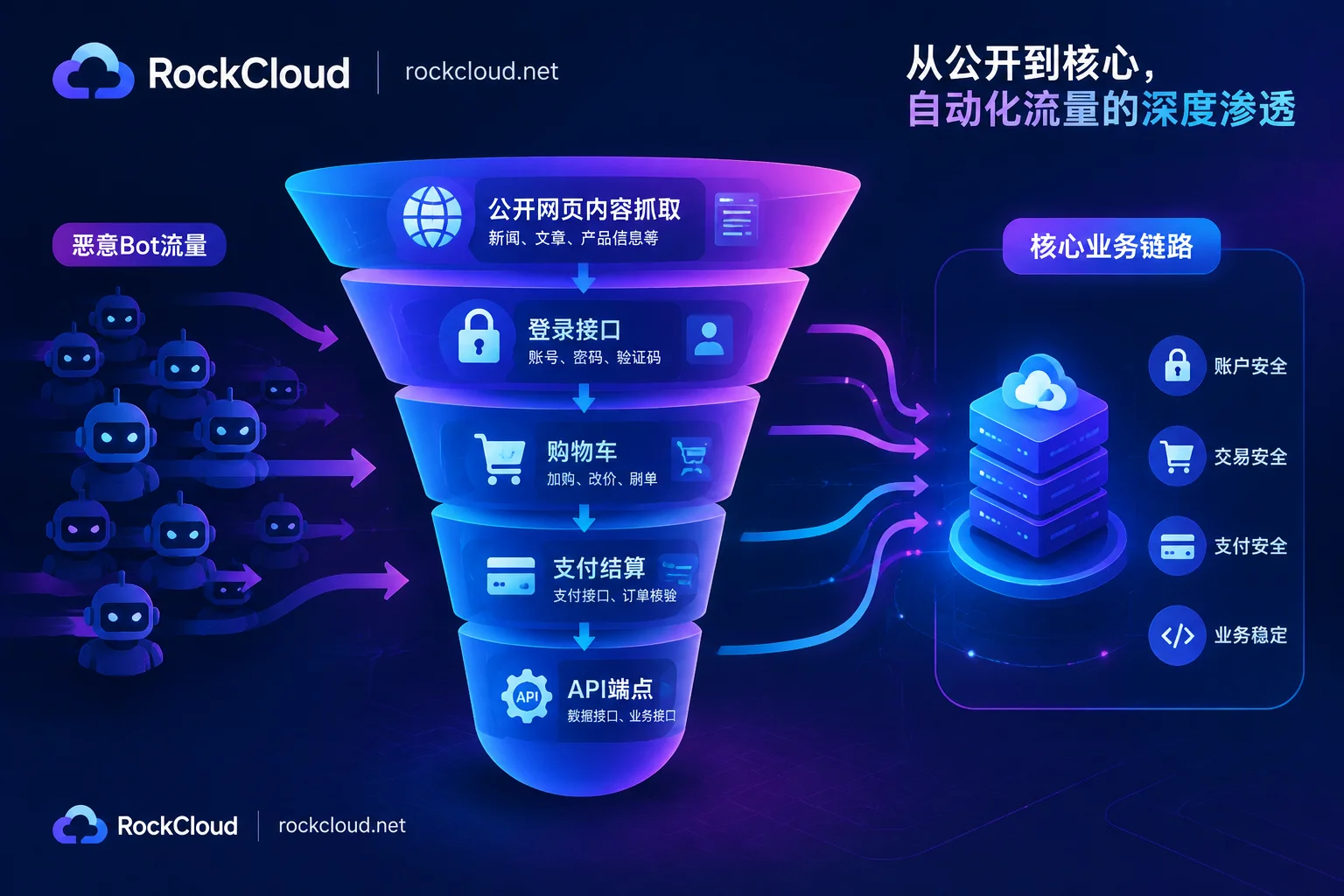
1. The State of Machine Traffic in 2026: From "Scanning Homepages" to "Drilling into Core Workflows"
In the past, security teams often treated crawlers and bots as background noise—nothing more than search engine spiders crawling pages or price comparison scripts scanning public directories. However, the latest global security monitoring data shows that this perception is seriously outdated.
According to DataDome's "State of Bot & Agent Security Report 2026," during the statistical period, malicious bot traffic surged by 124% year-over-year, growing more than 9 times faster than normal human traffic. More concerning for business leaders are the following three structural changes:
- Large-scale scraping remains the top threat: Malicious scraping accounts for 70.9% of all bad bot traffic and surged 185.2% year-over-year. Massive third-party data resellers and AI training data supply chains are endlessly draining server resources from content sites and vertical e-commerce platforms.
- Automated requests are massively invading core transaction workflows: In the first half of 2026 alone, AI-automated requests targeting high-risk endpoints such as login pages, forms, shopping carts, payment flows, and account registrations exceeded 605 million, with login pages alone accounting for 51.7%. Monthly automated visits to login endpoints increased more than 8-fold within half a year.
- Identity spoofing renders static rules useless: Up to 80% of new automation tools and AI agents do not honestly declare their identity but instead forge User-Agents of mainstream browsers or well-known crawlers (e.g., impersonating Meta or major search engine spiders). In tests across more than 20,000 popular websites worldwide, 65.3% of sites were defenseless against new bots and identity-spoofing automated scripts.
For businesses, this means unmanaged bots are not only wasting your origin compute power and bandwidth but also continuously performing credential stuffing, exploiting promotional offers, maliciously holding inventory, and probing API vulnerabilities. This is precisely the pain point we emphasized in "Beyond DDoS: Why Your Business Needs a Smarter 'Layer 7 Defense'": stealthy Layer 7 requests that don't cause full-site outages are often slowly draining your business in the background.
2. Why Traditional "Edit robots.txt + Block IPs" Can't Handle Today's Bots
When many development teams notice APIs being hammered, their first reaction is to write a few if ($http_user_agent ~* "...") blocking rules in Nginx or manually blacklist high-frequency IPs on the firewall. But in the current threat landscape, these three tricks quickly hit a ceiling:
1. Gentleman's Agreements Can't Stop Malicious Scraping and Spoofers
robots.txt only works for search engine spiders that follow the rules. Automated programs used for credential stuffing, scalping, or unauthorized corpus scraping not only completely ignore this protocol but also constantly rotate standard browser request headers or even run directly in headless browsers or cloud-hosted proxy browsers.
2. Low-and-Slow Attacks and Proxy Pools Bypass Single-Point Rate Limiting
Today's automation tools rarely use fixed data center IPs for brute force. Attackers use cheap residential proxy pools to distribute credential stuffing or scraping tasks that would otherwise burst from a single source across thousands of real home broadband IPs. Each IP sends only a few requests per minute, well below traditional single-IP rate limiting thresholds. (For details on such low-and-slow attacks, see the in-depth analysis in "How to Defend APIs and Dynamic Endpoints Against CC Attacks: Handling Low-and-Slow, Residential Proxies, and High-Concurrency API Flooding".)
3. "One-Size-Fits-All" Blocking Easily Harms Legitimate Traffic
In actual bot management implementation, the biggest fear is not failing to block but blocking the wrong thing. If you set security thresholds too rigidly:
- Legitimate search engine crawling is blocked, causing a cliff-edge drop in SEO rankings;
- Asynchronous callbacks (Webhooks) from third-party payment providers or normal API calls from partners are blocked as bots, directly causing lost orders;
- Normal users frequently refreshing pages during promotional peaks are misjudged and banned, triggering customer complaints.
3. Effective Bot Management Architecture: How to "Separate Truth from Falsehood" at Edge Nodes
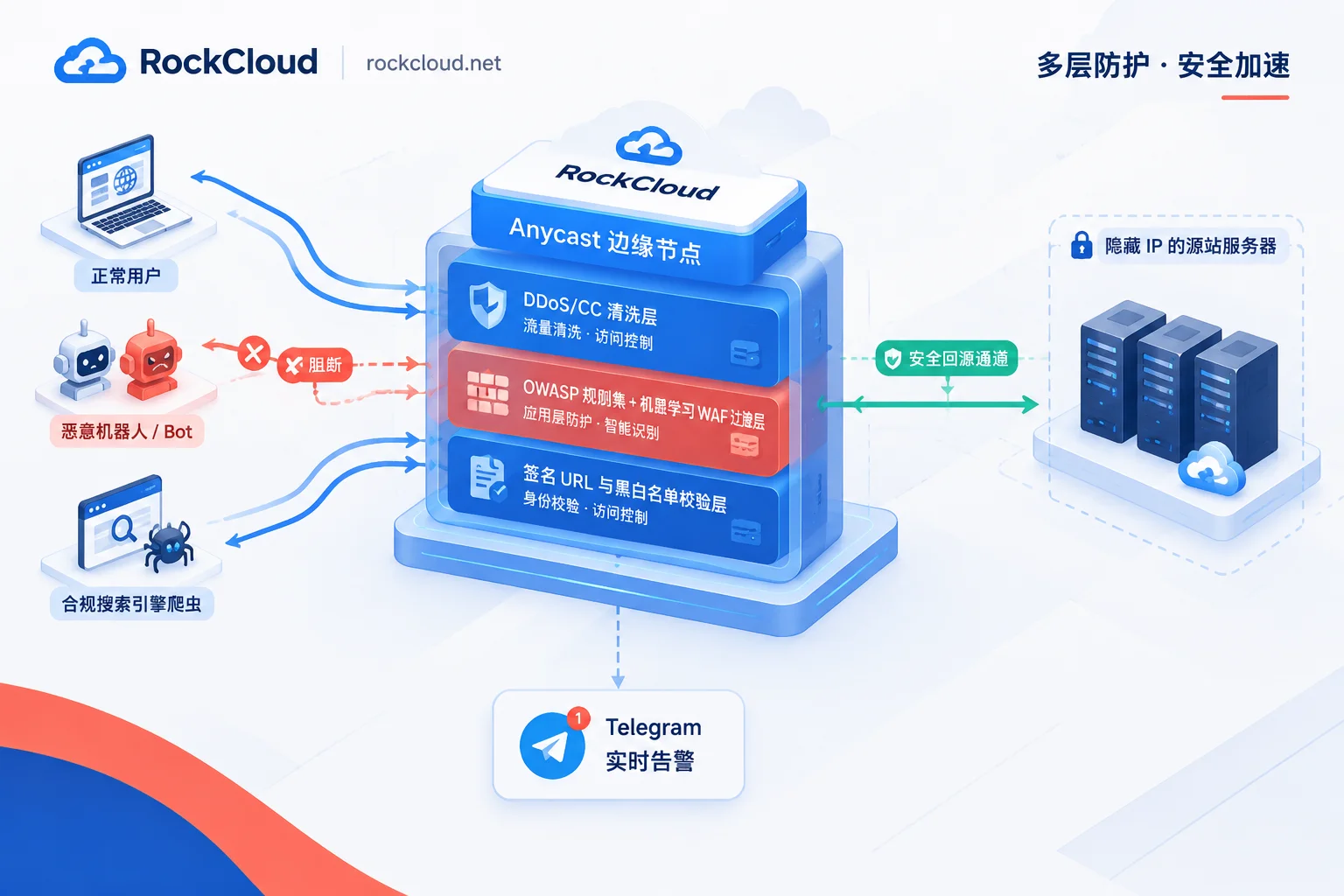
To free your origin from the heavy burden of machine traffic inspection, the most sensible approach is to move the bot management defense forward to a distributed edge network, completing identification, filtering, and allowlisting before traffic reaches your servers or cloud hosts.
Leveraging the integrated architecture of RockCloud Intelligent Web Application Firewall (WAF) and High-Defense CDN, enterprises can establish a fine-grained machine traffic control system through the following four dimensions:
1. OWASP Core Rule Set + Machine Learning Dynamic Identification
In the RockCloud control panel, operations staff can enable the intelligent WAF with one click. The system not only includes the mature OWASP Core Rule Set—which filters known malicious scripts, vulnerability scanners, automated probing tools, and SQL injection, XSS, and command injection attacks embedded in bot requests at the first checkpoint—but also introduces a machine learning engine.
For new variant bots not yet in the rule database or highly human-like scraping requests, the machine learning model can perform real-time identification through multi-dimensional request features and anomalous access patterns. This breaks free from reliance on static UA strings and greatly improves detection rates for unknown malicious bots.
2. Security Technical Team-Assisted Configuration: Distinguishing "Good Bots" from "Bad Bots"
Each industry has different core API logic: e-commerce needs to protect shopping cart and inventory APIs; gaming and social platforms need to protect login and registration APIs; and SaaS and payment businesses must ensure absolutely smooth high-frequency APIs and callback channels.
To avoid false positives from generic rules, RockCloud's custom rules and exception allowlisting are configured with assistance from a professional security technical team. Security engineers will help sort out and formulate fine-grained policies based on your actual business characteristics:
- Configure precise exception allowlisting for business-essential search engine spiders, overseas compliant scraping sources, or partner API nodes;
- Tighten bot identification and verification policies for high-frequency abused paths such as login, coupon claiming, and queries.
3. Multi-Dimensional Edge Access Control: Signatures, Black/White Lists, and Hotlink Protection
Beyond WAF-layer intelligent analysis, combined with RockCloud's general security and acceleration features, businesses can directly enable multiple hard boundaries at the edge:
- Security tokens and signed URLs: For core API endpoints, file downloads, or audio/video streams, require clients to carry time-limited encrypted signatures. Automated scripts without valid signatures are simply dropped at the CDN edge and cannot reach the origin at all.
- IP and region black/white lists: If your business only serves specific countries or regions, you can directly block high-risk attack source regions at the edge, instantly cutting out most of the noise from overseas proxy pools.
- Hotlink protection: Prevent external malicious sites or scrapers from directly stealing your static resources, images, and media files.
4. Hide Origin IP and Coordinate with DDoS/CC Defense on the Same Path
Many malicious bots, upon detecting anti-scraping restrictions, quickly escalate to high-concurrency application-layer CC attacks or even directly attempt to scan for the origin's real IP to bypass defenses.
When onboarding to RockCloud, you only need to add a CNAME record at your original DNS provider (no need to change NS; old and new paths run smoothly in parallel). After onboarding, Anycast distributed nodes completely hide your origin IP and perform DDoS scrubbing, CC defense, and WAF bot filtering simultaneously on the same request path. Operations teams only need to set "only allow RockCloud back-to-origin node IPs" on the origin firewall to completely seal off the backdoor for crawlers bypassing the CDN to connect directly to the origin. (If your origin IP has been exposed previously, be sure to change it simultaneously; for specific steps, see "Will the Origin IP Still Be Exposed After High-Defense CDN Onboarding: Five Leak Paths, Closure Order, and Post-Exposure Handling".)
4. Doing the Math: Don't Let Malicious Crawlers Run Up a Sky-High CDN Bill
When evaluating bot management solutions, one hidden risk that procurement and technical leaders most easily overlook is the billing model.
As we analyzed in "What to Do When CDN Is Maliciously Abused and DDoS Attacks Generate Sky-High Bills: Pay-As-You-Go Traps and High-Defense CDN Selection Guide", many cloud providers not only charge for CDN traffic by GB but also impose additional fees for their advanced bot management modules or WAF rule checks per million requests.
When large-scale AI crawlers or credential stuffing scripts launch hundreds of millions of probing requests against your site overnight, even if these requests are successfully blocked at the edge or return 403 status codes, pay-as-you-go bills will still keep ticking, meaning enterprises block the attack but still pay for the junk requests generated by malicious actors.
To eliminate this financial unpredictability, RockCloud's package billing model adopts a design more aligned with the essence of protection:
- Monthly billing based on fixed peak bandwidth, with unlimited traffic and unlimited requests: No matter how many hundreds of millions of scraping or credential stuffing attempts malicious bots make in a month, no excess bills based on request count or traffic will be generated.
- All features integrated: Acceleration and defense are delivered on the same path and in the same package. DDoS/CC defense, intelligent WAF (including bot identification), and free fully automated SSL are all included—no need to separately purchase security modules.
- Real-time visualization and alerts: The control panel provides clear traffic and bandwidth reports, detailed network log queries, and supports real-time Telegram data push. Once an API experiences an abnormal surge in machine traffic, the operations team can receive alerts immediately and coordinate with the security team to adjust policies.
Conclusion
In an era where automated tools and AI agents are everywhere, bot management has evolved from an "optional optimization" to infrastructure that ensures business availability and data asset security. Rather than continuously piling up complex code-level anti-scraping logic on origin servers and consuming valuable CPU and database performance, it's better to hand this filtering layer to a professional edge security network.
If your website, WEB API, APP, payment channel, or AI service is suffering from malicious crawler scraping, high-frequency credential stuffing, or automated script abuse, welcome to check out RockCloud Industry Solutions, or go directly to the Contact Page and official Telegram (@rockclouds) to communicate with our customer service and security response team. You can first determine your business specifications and apply for a free test to quickly verify the fine-grained traffic control effects of Edge WAF and High-Defense CDN without changing your existing architecture or origin servers.




Comments(0)