 RockCloud-基石云安全-官方博客
2026 DDoS New Normal: Massive Traffic and L7 Hybrid Attacks
According to the May 2026 DDoS Threat Analysis by cybersecurity firm MazeBolt, global infrastructure faces extremely severe attack risks. In May alone, multiple overseas hosting service providers suffered sustained DDoS attacks, causing network outages for tens of thousands of downstream businesses. Meanwhile, Radware's "Q1 2026 Network and Application Attack Trends Report" indicates a 187.1% year-on-year surge in Web DDoS attack volume and a 168.2% increase in network-layer DDoS attacks in Q1 2026.
Even more striking, the latest security reports from NETSCOUT and Cloudflare both confirm that DDoS attack peaks driven by new IoT botnets have crossed the 30 Tbps threshold. Attackers now rarely use single traffic floods; instead, they commonly adopt AI-automated hybrid strategies combining massive L3/L4 traffic with complex L7 application-layer attacks (CC attacks, API abuse), putting enormous pressure on enterprise infrastructure.
Limitations and Blind Spots of Relying Solely on High-Protection Servers
When facing traditional hundred-gigabit-level attacks, enterprises typically purchase "high-protection servers" as direct origin servers. However, against 30 Tbps-level massive traffic and automated L7 attacks, relying solely on a single high-protection server node presents clear defense bottlenecks:
- Upstream Link Congestion: While hardware firewalls in high-protection server rooms can filter malicious packets, if attack traffic exceeds the total upstream bandwidth of the data center, the physical link is instantly saturated, preventing legitimate users' TCP connections.
- Application Layer Resource Exhaustion: HTTP/2 bottlenecks and complex dynamic requests (e.g., database queries, login authentication) can quickly deplete CPU and memory resources of high-protection servers. Pure hardware firewalls cannot accurately identify deeply disguised legitimate HTTP requests.
- Real IP Exposure Risk: If the real IP of a high-protection server is exposed to the public, attackers can bypass domain names or find side ports to directly scan and attack the origin server, rendering the defense system completely ineffective.
Four Key Factors and Checklist for Enterprise High-Protection Server Selection
To ensure business continuity, enterprises should evaluate high-protection server procurement and configuration from the following four dimensions:
- Scrubbing Capacity and Bandwidth Redundancy: Understand the single-node defense cap (e.g., 100Gbps, 500Gbps, or 1Tbps+) and the elastic scalability of the BGP line.
- Protocol and Application Layer Recognition: Whether the high-protection server is equipped with intelligent WAF and CC filtering mechanisms capable of real-time decryption and feature matching for HTTPS encrypted traffic.
- Smart Routing and Anycast Coverage: Whether the data center or network supports multi-node Anycast smart routing, allowing automatic traffic distribution to global scrubbing centers during massive attacks.
- Origin Server Camouflage and Security Startup Mechanism: Whether the server supports allowing only authorized proxy node IPs to access, preventing origin server address leakage.
High-Protection Defense Architecture Checklist
- [ ] Origin server configured with security groups allowing only scrubbing node IPs.
- [ ] Rate limiting configured for high-frequency API endpoints.
- [ ] UDP/TCP anomalous packet filtering and SYN Cookie verification enabled.
- [ ] Elastic CDN caching and static disaster recovery pages prepared.
RockCloud Layered Defense Architecture: High-Protection CDN and Origin Server Collaboration
Faced with increasingly complex network threats, the protective effect of a single product is often limited. Building a layered defense system of "edge scrubbing + smart acceleration + origin protection" has become industry consensus.
RockCloud publicly offers high-protection CDN, DDoS and CC defense, intelligent WAF, game shield, Anycast global network acceleration, CN2 China direct line, caching and log services, along with security rules and technical support for complex businesses. In such massive traffic attack scenarios, RockCloud helps enterprises place origin high-protection servers behind a security barrier:
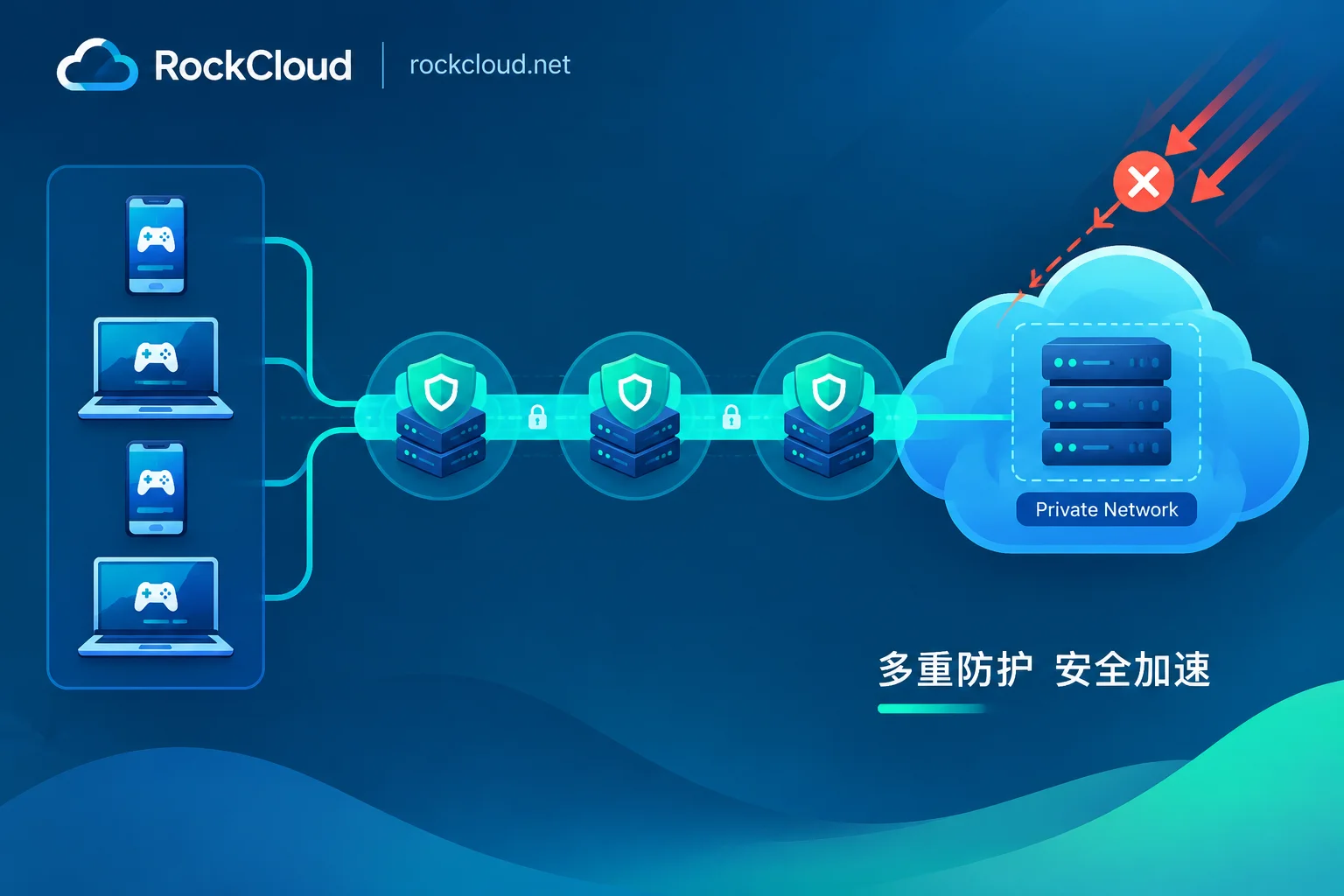
- Edge Traffic Absorption: Utilizing RockCloud's Anycast global network acceleration and distributed high-protection CDN, Tbps-level L3/L4 attack traffic is distributed and scrubbed at the network edge, preventing massive data from directly impacting the origin server.
- Application Layer Intelligent Filtering: Combined with RockCloud's intelligent WAF and game shield capabilities, high-frequency CC attacks, HTTP slow attacks, and automated bot requests are accurately identified. Only cleaned traffic is sent back to the origin via CN2 China direct line or secure tunnel.
- Origin Server Hiding and Zero-Downtime Disaster Recovery: Through proxy isolation at edge nodes, the real IP of the origin high-protection server is completely hidden, maintaining zero business interruption even during massive peak attacks.
Conclusion and RockCloud Business Security Assessment
In 2026, with industrialized attack techniques and AI-driven threats, enterprises selecting high-protection servers must look beyond the "hard defense numbers" of a single data center and adopt a globally coordinated layered defense perspective. By synergizing high-protection servers with edge high-protection CDN/WAF, enterprises can ensure high availability while significantly reducing overall bandwidth and operational costs.
If your business faces traffic attack threats or you wish to evaluate the anti-DDoS performance of your current high-protection server architecture, it is recommended to contact the RockCloud security team for customized protection solutions and technical support.



Comments(0)