 RockCloud-基石云安全-官方博客
Attack Paradigm Reconstruction: AI Botnets Push Defense Limits
With the proliferation of AI technology and industrial hacking tools, DDoS attacks have evolved from traditional bandwidth stacking to high-precision intelligent warfare. In its latest security bulletin released in July 2026, cybersecurity firm NETSCOUT noted that to counter AI-driven automated botnets such as Aisuru-Kimwolf and increasing direct path attacks, its network-layer defenses have been significantly upgraded to 33 Tbps. Meanwhile, according to Cloudflare Radar's threat report, network-layer DDoS attack volumes have surged sharply, with hyper-volumetric attack peaks reaching a record 31.4 Tbps, and individual attacks now lasting only minutes or even tens of seconds, exhibiting new characteristics of "short duration, high frequency, and composite variability."
This industrialized and intelligent attack trend poses a severe survival test for enterprise origin servers. Attackers leverage AI to complete probe scanning and automated attack vector assembly within seconds, launching multi-wave UDP/SYN floods and application-layer CC attacks against unprotected single public IPs.
Why Traditional Single-Node Defenses Fail: How High-Defense IP Works and Its Core Advantages
Under multi-terabit traffic floods, relying on enterprise-built firewalls or local IDC bandwidth scrubbing is like a mantis trying to stop a chariot. High-Defense IP (HDIP) becomes the first solid line of defense to ensure business continuity.
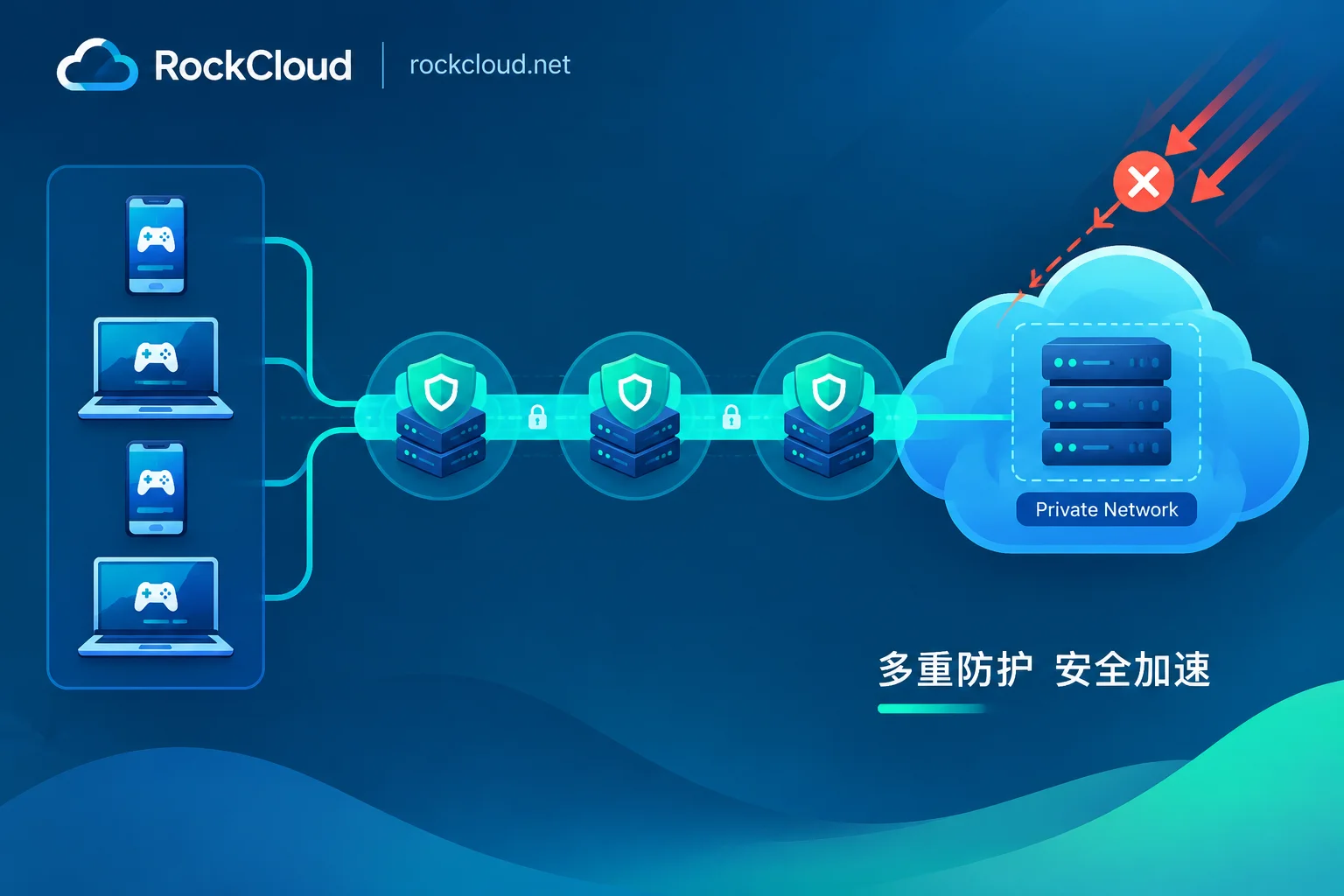
The essence of high-defense IP is to redirect malicious attack traffic destined for the origin server to backbone nodes with large bandwidth and intelligent scrubbing through IP hiding and traffic redirection:
- IP Concealment and Origin Protection: The enterprise resolves its business domain to the high-defense IP or replaces the external service address with the high-defense IP, making the real origin IP invisible and cutting off direct attack paths.
- BGP Intelligent Routing and Traffic Scrubbing: High-defense IP leverages multi-line BGP resources and Anycast global networks to receive incoming traffic in real time. At the scrubbing nodes, deep packet inspection (DPI) algorithms and AI filtering rules rapidly block SYN Flood, ACK Flood, UDP floods, and DNS reflection attacks.
- Clean Traffic Back to Origin: After scrubbing by the high-defense IP system, safe business traffic is precisely forwarded to the enterprise origin server via tunnels or reverse proxies, ensuring normal user access experience is unaffected.

RockCloud Deep Defense System: From High-Defense IP to Full-Chain Security Acceleration
While high-defense IP is highly effective at mitigating L3/L4 backbone network-layer attacks, it often falls short against complex L7 application-layer CC attacks, API crawlers, and business logic exploits when used alone.
As a professional cloud service provider for enterprise operations and security teams, RockCloud combines global network architecture and real-world security offensive and defensive experience to build a three-dimensional protection matrix integrating high-defense IP, high-defense CDN, intelligent WAF, and game shield:
- L3/L4 Massive Scrubbing and Anycast Acceleration: Relying on a global Anycast network paired with an intelligent scrubbing system, it shares and mitigates Tbps DDoS floods at the network edge in real time, ensuring high-defense IP nodes are not overwhelmed.
- L7 Intelligent WAF and CC Dynamic Defense: Against high-frequency HTTP/HTTPS attacks and algorithmic CC floods, RockCloud's intelligent WAF uses behavioral fingerprints and access rates to dynamically intercept malicious requests, achieving zero false positives.
- Premium Link Guarantee (CN2 China Direct Route): For cross-border businesses and latency-sensitive applications, RockCloud offers CN2 premium direct routes combined with high-defense IP, ensuring smooth access for domestic and global users even under attack.
Enterprise High-Defense IP Architecture Selection and Deployment Checklist
When adopting high-defense IP or selecting security protection services, enterprise operations and security teams should follow these core steps to ensure defense effectiveness:
| Evaluation Dimension | Key Focus | Recommended Action |
|---|---|---|
| Origin Exposure Prevention | Whether the real origin IP is exposed | Change origin IP before adopting high-defense IP; configure origin security group to allow only scrubbing node back-to-origin traffic |
| Scrubbing Capacity and Protocol Compatibility | Business supported protocols (TCP/UDP/HTTP) | Confirm if high-defense IP supports non-web protocol back-to-origin and custom UDP filtering rules |
| Latency and Network Route | Node access latency and BGP quality | Choose providers with multi-line BGP and CN2 premium route acceleration to avoid increased business latency |
| Emergency Response and Rule Tuning | Response speed during attacks | Ensure 24/7 technical support and custom rule adjustment permissions |
For complex scenarios such as high-concurrency gaming, financial trading, and cross-border e-commerce, it is recommended to deploy high-defense IP combined with high-defense CDN or game shield in layers, building a deep defense barrier from the network edge to the application origin to fully protect business stability and response experience.



Comments(0)